Gear Type Coupling in Rolling Mill Main Drive Systems: A Comprehensive Engineering Guide
🏴 UK Steel & Metallurgy
⚙ Drive Systems Engineering
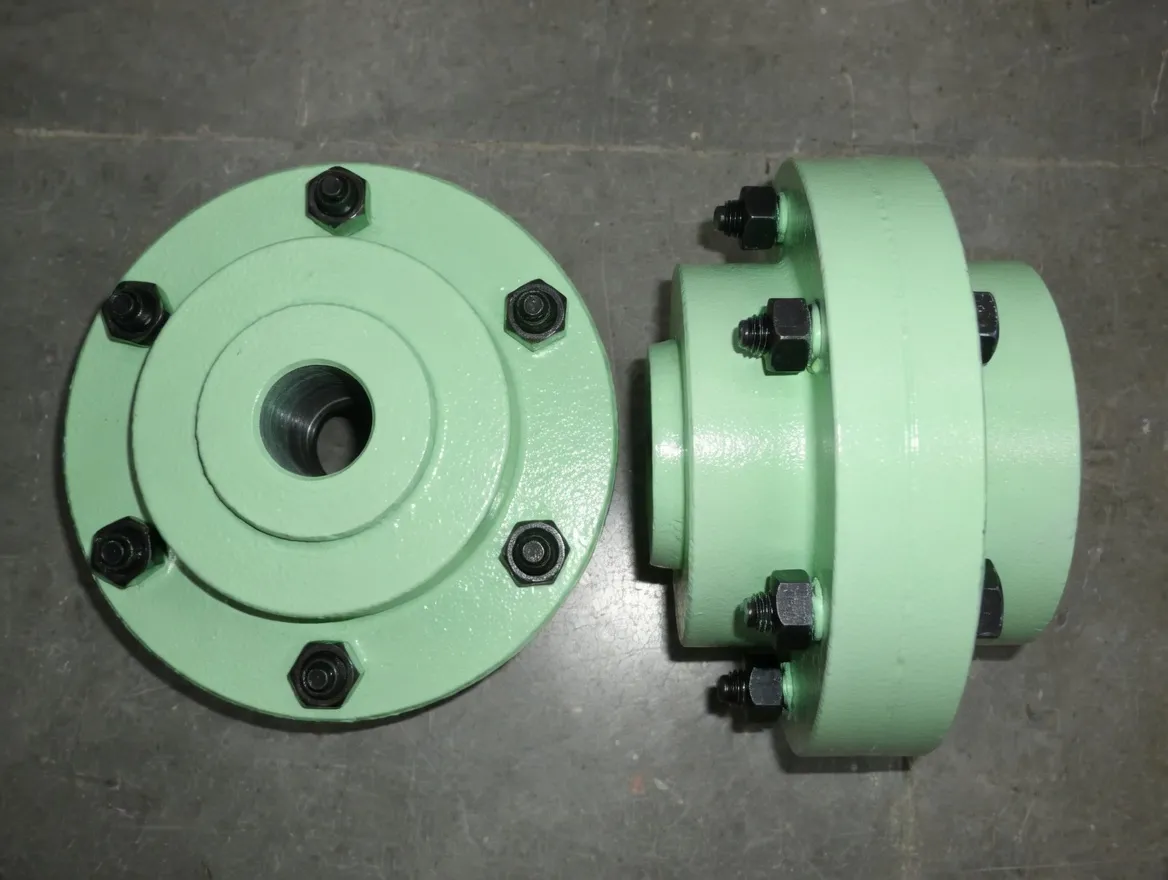
Rolling mills sit at the very heart of steel and metallurgical production across the United Kingdom — from the heavy plate mills in Scunthorpe to the high-speed rod lines in Cardiff. Whether a plant is running a hot strip mill at temperatures above 1,200 °C or a cold tandem mill pushing yield strengths to the limit, the transmission chain connecting the main drive motor to the work rolls is only as reliable as the coupling joining every shaft in line. The gear type coupling — with its robust external and internal gear mesh, its generous torque capacity, and its ability to absorb both angular and axial misalignment — has been the coupling of choice for rolling mill main drive systems for decades, and it remains the dominant solution in new installations and refurbishment projects throughout Britain and Europe today.
Why Rolling Mill Drive Systems Demand a Heavy-Duty Gear Type Coupling
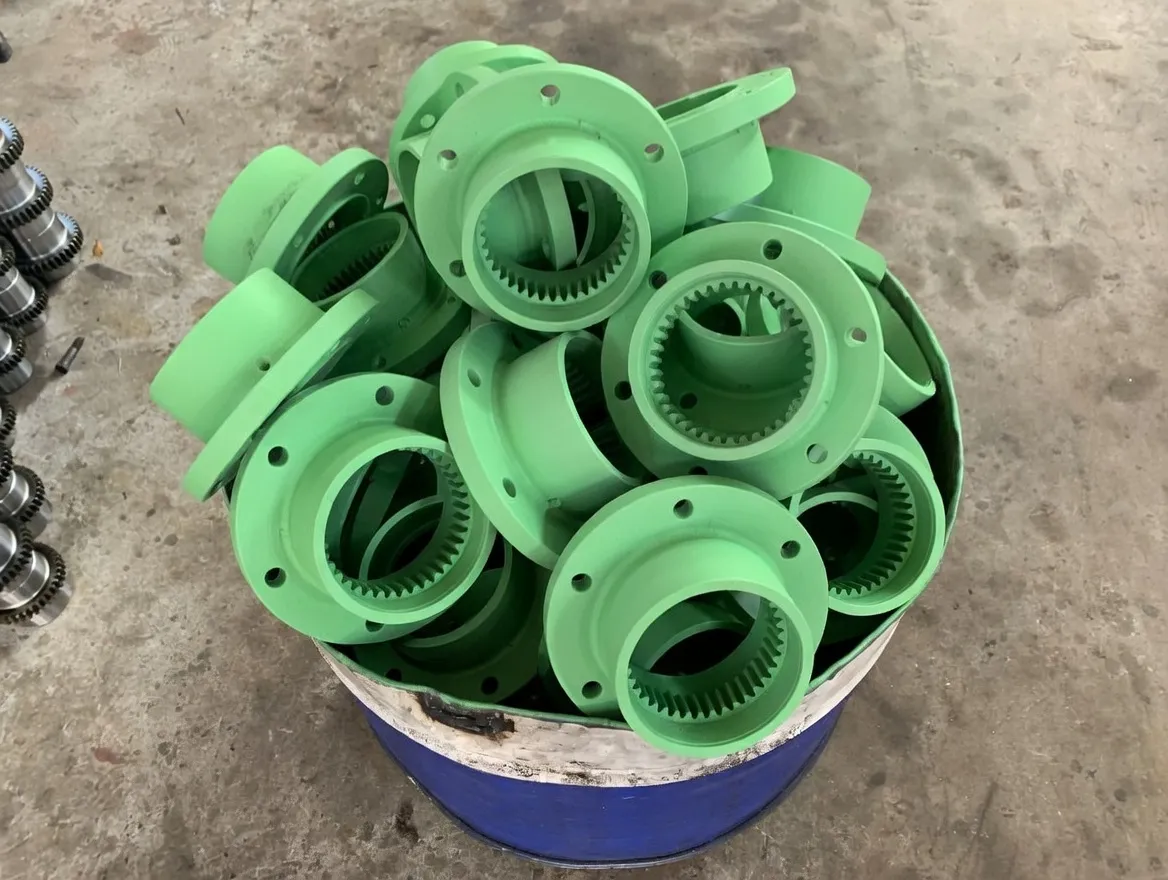
The engineering demands placed on a rolling mill drive coupling are unlike almost any other industrial application. During the bite moment — when the leading edge of a billet or slab enters the roll gap — the torque spike transmitted through the drive train can reach two to three times the rated running torque in milliseconds. A standard jaw coupling or disc coupling simply cannot absorb this kind of peak loading without risk of fatigue failure. The gear type coupling, by contrast, distributes load across multiple gear teeth, achieving peak torque capacities that can reach tens of thousands of Newton-metres in larger WGZ and SWC series designs. This is not over-engineering; it is the minimum specification that a competent rolling mill engineer would accept for continuous production service in a UK steel plant.
Beyond sheer torque, there is the matter of misalignment. Roll gap adjustment is a continuous process: the operator raises and lowers the top roll assembly to hit specific product gauge targets, and every adjustment shifts the shaft centerlines relative to each other. A gear type coupling accommodates angular misalignment of up to 1° to 1.5° per gear mesh — and in a double-engagement design (two sets of external-internal gear pairs in series), that doubles the total compensation available. Axial float is equally important; thermal expansion of the roll bodies and spindles can produce axial displacement of several millimetres, and the coupling sleeve must slide freely along the hub tooth profile to absorb this movement without generating destructive axial thrust forces on the motor or gearbox bearings.
Technical Performance Parameters — Rolling Mill Gear Type Coupling
| Parameter | SWC Series (Arc Tooth) | WGZ Series (Drum Gear) | Notes |
|---|---|---|---|
| Nominal Torque Range | 4,000 – 4,000,000 N·m | 3,150 – 3,150,000 N·m | Per GB/T 5903 |
| Max Angular Misalignment | 1.5° per mesh | 1.0° per mesh | Double-flex doubles total |
| Axial Displacement | ±2 – ±15 mm | ±3 – ±20 mm | Size dependent |
| Operating Speed | Up to 1,500 rpm (heavy) | Up to 1,200 rpm (heavy) | Balance grade G6.3 |
| Safety Factor (recommended) | ≥ 2.5 | ≥ 2.5 | Rolling mill standard |
| Tooth Profile | Crowned arc tooth | Drum-shaped (barrel) gear | Improved edge load distribution |
| Lubrication Method | Grease or circulating oil | Circulating oil (preferred) | Oil bath for high duty |
| Material (standard) | 42CrMo4 alloy steel | 42CrMo4 alloy steel | Carburised option available |
Key Advantages of Using a Gear Type Coupling in Your Rolling Mill Drive
Extreme Torque Capacity
The crowned tooth geometry and case-hardened 42CrMo4 steel allow a gear type coupling to transmit peak torques that few other coupling designs can match, making it the natural choice for mill drives with severe overload events.
Multi-Axis Misalignment Tolerance
Simultaneous compensation for angular deviation, parallel offset, and axial float in a single compact assembly means roll gap adjustments never place excessive side-loads on gearbox or motor bearings.
Sealed Against Mill Environment
Labyrinth-type sealing rings and positive-pressure grease retention prevent mill scale, cooling water, and process steam from contaminating the gear mesh — a critical feature for UK hot rolling operations.
Long Service Life & Low Maintenance
When correctly selected with a safety factor of at least 2.5 and lubricated on schedule, a gear type coupling on a rolling mill main drive routinely delivers 3 to 5 years of uninterrupted service between planned overhauls.
High Mechanical Efficiency
The steel-on-steel gear mesh of a well-lubricated gear type coupling operates at efficiencies above 99%, ensuring that motor energy is transmitted to the rolls rather than dissipated as heat in the coupling itself.
Rapid Roll Change Compatibility
The split-sleeve and floating-shaft configurations used in rolling mill gear type couplings enable roll change operations within narrow maintenance windows, keeping annual production hours at maximum.
How a Gear Type Coupling Works in a Rolling Mill Context
The fundamental operating principle of a gear type coupling centres on the meshing engagement between an externally toothed inner hub and an internally toothed outer sleeve. In the rolling mill main drive, a double-engagement (double-flex) gear type coupling is almost universally preferred. It comprises two hubs — one splined or keyed to the pinion stand output shaft, the other to the roll spindle — and a central floating sleeve that carries the internal teeth at both ends. Torque flows from the drive side hub teeth, through the sleeve, and out through the driven hub, with the crowned profile of the external teeth allowing each mesh to rock through the misalignment angle without edge loading.
The crowned tooth — also called the barrel tooth or arc tooth — is the design feature that separates a modern gear type coupling from older straight-cut designs. By crowning the flanks of the external teeth along both the involute profile direction and the face width direction, the tooth contact patch shifts gracefully toward the centre of the face as misalignment increases, rather than concentrating stress at the tooth edge. This dramatically reduces Hertzian contact stress under misaligned conditions and extends the fatigue life of the coupling under the cyclic torque loading typical of a rolling mill drive cycle.
Materials matter enormously in this environment. The standard specification for rolling mill service is 42CrMo4 chromium-molybdenum alloy steel, quench-and-tempered to a core hardness of 28–34 HRC and case-carburised to achieve tooth flank hardness of 58–62 HRC. This combination delivers the fatigue strength needed to survive millions of load cycles without surface pitting, while maintaining adequate core toughness to absorb impact loading at bite without brittle fracture. In some high-impact applications, through-hardened 34CrNiMo6 is preferred for its superior impact absorption characteristics, and Ever Power’s engineering team can advise on material selection based on your specific rolling programme and shutdown interval targets.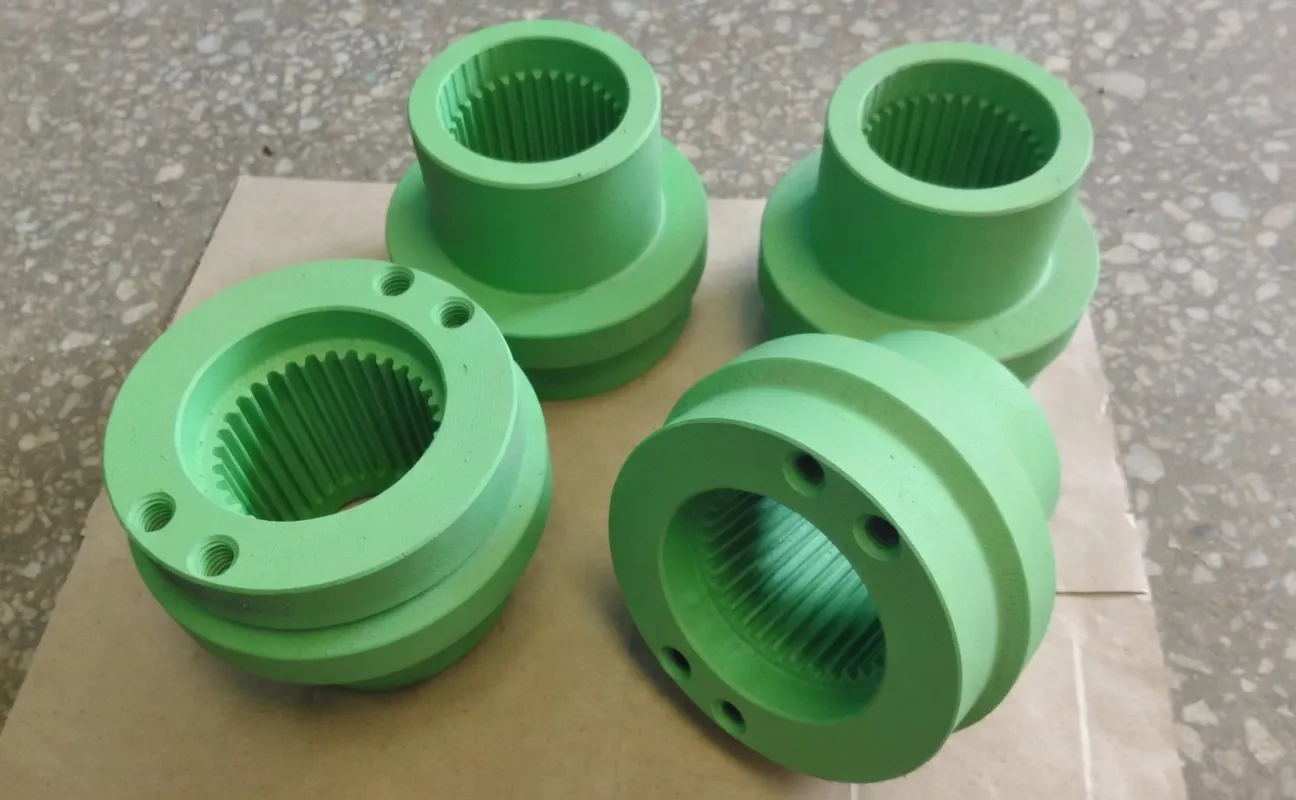
Rolling Mill Application Scenarios for Gear Type Couplings
Hot Strip Mill
Motor-to-gearbox and gearbox-to-roll spindle connections in roughing and finishing stands. Torques typically 200,000 – 2,000,000 N·m. High ambient temperature demands regular oil analysis and lip seal inspection.
Cold Tandem Mill
High-speed, high-precision cold rolling of automotive and electrical sheet demands dynamic balancing to G6.3 or better. The gear type coupling’s rigid torsional stiffness reduces speed variation between stands.
Rod & Bar Mill
Compact WGZ-type gear couplings connect driven rolls in roughing, intermediate, and finishing groups. Frequent roll changes make the split-sleeve quick-change design a significant maintenance time-saver.
Heavy Plate Mill
Reversing plate mills in UK shipbuilding and structural steel supply chains run at lower speeds but with extremely high torques. SWC series couplings up to 4,000,000 N·m are deployed at motor coupling and pinion coupling positions.
Tube & Pipe Mill
The helical forming and sizing stands in ERW and seamless tube mills generate complex combined loading on drive spindles. Gear type couplings with extended floating shaft handles the large centre distance between drive and roll.
Section & Rail Mill
Universal rolling of I-beams, H-sections, and railway rails demands coupling configurations that handle both horizontal and vertical roll drives simultaneously. Gear type couplings are standard on both horizontal and edging stand drives.
Selecting the Right Gear Type Coupling for Your Rolling Mill — A Practical Guide
Getting the selection right at the engineering stage is the single most effective investment a UK rolling mill operator can make. An undersized gear type coupling — one chosen solely on rated torque without adequate safety factor — will fail prematurely during peak load events, causing costly unplanned shutdowns and potential secondary damage to gearboxes and motor shafts. An oversized coupling adds unnecessary mass and rotational inertia to the drive train, increasing motor energy consumption and slowing the acceleration response of the mill. The engineering objective is to hit the optimal window: a safety factor of 2.5 to 3.0 on peak torque, with a coupling whose physical envelope fits within the existing mill housing geometry.
The selection calculation starts with the nominal motor torque, corrects it for the gearbox ratio to find the coupling input torque, and then applies the mill-specific service factor. For a hot rolling roughing stand with severe bite impact, the service factor will typically be 2.0 to 2.5 on top of the base torque, yielding a selection torque that can be two to five times the steady-state running torque. The coupling catalogue torque must exceed this selection torque. After confirming the torque rating, the engineer verifies that the bore diameters can accommodate the shaft sizes, that the coupling overall length and flange dimension match the mill layout, and that the maximum angular misalignment rating covers the expected roll gap adjustment range.
For new mill installations in the UK — whether in Sheffield, Newport, Scunthorpe, or Motherwell — the choice between SWC arc-tooth and WGZ drum-gear types often comes down to speed and available installation length. The SWC series excels where longer spans and higher misalignment angles are needed, while the WGZ design is favoured in compact pinion stand positions where axial envelope is constrained. Ever Power engineers can provide a full application review and recommendation at no charge; simply send your drive data to the enquiry address below.
Customer Success Case Study: Sheffield Long Products Rolling Mill, UK
Reducing Unplanned Downtime on a Reversing Plate Mill Main Drive
Background: A long-established South Yorkshire steel producer was experiencing frequent coupling failures on the main drive of their reversing plate mill — on average, one unplanned coupling replacement every 6 to 8 months. The previous couplings, sourced from a domestic supplier, were straight-tooth gear type couplings rated to 1,800,000 N·m. Tooth surface pitting and fretting wear were the consistent failure modes, attributed to insufficient tooth crowning and a safety factor that had been calculated at only 1.8 against peak bite torque.
Solution: Ever Power supplied a pair of SWC series arc-tooth double-flex gear type couplings, designed to 2,800,000 N·m nominal rating (safety factor of 2.8 against peak bite torque). The crowned tooth geometry was optimised for the mill’s angular misalignment envelope of ±1.2°. Circulating oil lubrication with an inline temperature sensor was added to allow continuous condition monitoring without manual inspection intervention.
Result: Following installation in Q3 2022, the mill ran for 26 months to the first planned overhaul without any coupling-related stoppage. Tooth wear inspection at the overhaul found surface condition rated as “serviceable for a further 18 to 24 months.” The plant engineering manager estimated that avoiding three unplanned couplings failures over a two-year period saved the mill operator over £280,000 in lost production time and emergency maintenance costs.
What Our Customers Say
“We switched to Ever Power SWC couplings across our rod mill finishing block last year. The arc tooth profile is noticeably smoother running, and we’ve had zero tooth wear issues through the first full rolling campaign. The technical support before ordering was excellent — they checked our torque calculations independently before confirming the spec.”
— Senior Mechanical Engineer, Rotherham Bar Products, UK
“The delivery lead time was the deciding factor for us — we needed a replacement WGZ coupling for our hot strip rougher within 14 working days. Ever Power hit that target, and the coupling arrived with full material certification and dimensional inspection reports. That level of documentation matters a lot when you’re signing off on safety-critical components.”
— Plant Maintenance Manager, Newport Strip Mill, Wales, UK
“We used Ever Power for a customised gear type coupling on our experimental thin-slab caster-direct-rolling line. The bore tolerance and keyway geometry were non-standard, and Ever Power machined to our drawings exactly. The coupling ran perfectly from first start-up. I’d recommend them without hesitation to any UK rolling mill operator looking for a reliable gear coupling supplier.”
— Chief Design Engineer, Teesside Research Rolling Centre, UK
Ever Power Manufacturing & Custom Engineering Capability
Ever Power’s gear type coupling manufacturing facility operates dedicated CNC gear-hobbing and grinding lines capable of producing external and internal gear sets from module 3 through module 30, covering the full torque range required for rolling mill applications from small section mills up to the heaviest plate and strip mill drives. The machining capability extends to maximum hub bores of 920 mm and overall coupling outside diameters in excess of 1,400 mm — dimensions that place us among the relatively small number of manufacturers globally able to supply the very largest rolling mill gear couplings from a single factory.
Custom design and engineering is a core competency, not a secondary service. Rolling mill couplings are inherently application-specific: shaft diameters, keyway dimensions, flange bolt circles, centre distances, and misalignment envelopes all vary between mills and even between stands within the same mill. Ever Power’s engineering team works directly from customer drawings, or from field measurements provided by the customer’s maintenance engineers, to design a coupling that fits precisely within the existing installation envelope. Material upgrades, non-standard bore tolerances (H6/H7 or to customer specification), special seal configurations, and surface coating options (including heavy-duty anti-corrosion treatments for coastal UK plant locations) are all available. Every custom coupling order is accompanied by a full dimensional inspection report, material test certificates traceable to heat batch, and gear tooth profile verification data.
Frequently Asked Questions — Gear Type Coupling for Rolling Mill Drive Systems
Supplying engineered gear type couplings to rolling mills, steel plants, and heavy industry across the United Kingdom and worldwide. Custom design, full material traceability, and rapid delivery.