
Why Rotary Table Drives Place Unique Demands on the Gear Type Coupling
The conventional rotary table is the mechanical centrepiece of onshore and offshore drilling operations across the United Kingdom — from the central North Sea sector managed out of Aberdeen, to onshore exploration licences in Lincolnshire, the East Midlands, and the Weald Basin in southern England. The drive chain that turns the table typically starts at a diesel engine rated between 600 kW and 1,500 kW, passes through a multi-ratio gearbox, and terminates at the table pinion. It is a chain that carries enormous torque, and it is a chain that never runs in perfect alignment.
A rig substructure assembled on-site in a matter of days is never as precisely aligned as equipment assembled in a controlled workshop. Thermal expansion moves shafts by fractions of a millimetre as engine temperatures rise from cold-start to full operating temperature. On a semi-submersible or jack-up platform in the North Sea, structural flex under wave loading introduces continuous low-amplitude misalignment cycles that would fatigue a rigid coupling beyond its design life inside a single drilling campaign. Add to this the torque variability inherent in rotary drilling — nominal torque might be 80,000 N·m at steady-state, but hitting an unexpected chert inclusion at 3,000 metres can spike that figure to 240,000 N·m within milliseconds — and it becomes clear why an ordinary rigid coupling is simply not fit for this service.
The gear type coupling was developed precisely to meet this combination of challenges. Its crowned-tooth external hubs mesh inside a flanged sleeve in a configuration that accommodates angular misalignment of up to 1.5 degrees, axial shaft movement of several millimetres, and radial offset — simultaneously, and without generating destructive edge loads on the tooth flanks. The torque is transmitted through multiple tooth contacts distributed around the circumference, so no individual tooth face ever sees the full shock impulse. Drilling mud, saltwater, and temperature extremes from North Sea winters to diesel engine heat are managed by the coupling’s sealing system and material specification. For UK-based operators, this engineering package is not a premium option — it is the baseline for reliable rotary drilling.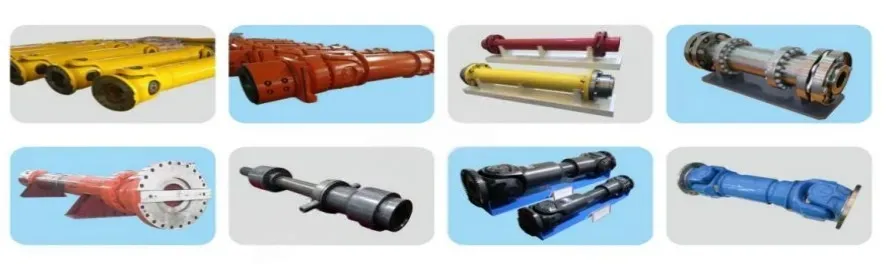
Technical Performance Parameters for Drilling Rig Applications
The table below outlines typical performance parameters for gear type couplings configured for rotary table and top-drive applications. Actual values depend on hub bore size, rated speed, service factor, and the specific rig configuration. Ever Power’s engineering team sizes each unit individually against the customer’s rig specification sheet and drilling programme — catalogue selection alone is insufficient for hard-formation or deep-well drilling.
| Parámetro | Standard Catalogue Range | Heavy-Duty / Custom | Unidad |
|---|---|---|---|
| Par nominal | 5,000 – 250,000 | Up to 800,000 | Nuevo Méjico |
| Velocidad máxima de funcionamiento | 100 – 1,500 | Up to 3,200 | rpm |
| Desalineación angular | 0° – 1.5° | Up to 2.5° | títulos |
| Desplazamiento axial | ±2 – ±6 | ±12 | mm |
| Transmission Efficiency | 98.5 – 99.2 | Up to 99.5 | % |
| Operating Temperature Range | -20 a +80 | -40 to +120 | °C |
| Tooth Backlash (mesh clearance) | 0.05 – 0.15 | Precision to 0.03 | mm |
| Hub Material Standard | 42CrMo4, 40Cr | 18CrNiMo7-6, 17NiCrMo6 | — |
| Seal Configuration | O-ring / single-lip seal | Double-labyrinth + O-ring | — |
| Tratamiento de superficies | Phosphating + industrial grease | Nickel plate / HVOF carbide coat | — |
Six Decisive Performance Advantages in Drilling Operations
Extreme Torque Capacity
Drilling through hard limestone, dolomite, or shale can spike torque to two or three times the steady-state value in a fraction of a second. The gear type coupling’s involute-crowned tooth profile distributes these shock impulses across a large contact area, preventing catastrophic tooth failure and protecting the gearbox from sudden overloads that would destroy an equivalent rigid connection.
Combined Misalignment Tolerance
Field rig-up on a North Sea platform or remote onshore site is never as precise as workshop alignment. The gear type coupling accommodates angular, axial, and radial misalignment simultaneously, so the drive system runs smoothly even when the prime mover and gearbox are not perfectly collinear after a rapid assembly under field conditions.
Drilling Mud Resistance
Drilling mud is a relentless contaminant. A properly engineered gear type coupling uses double-labyrinth seals combined with positive grease retention to exclude mud while keeping lubrication in place. The sealed cartridge design allows continuous operation in mud-spray environments without accelerated wear of the tooth mesh, which is one of the most common failure modes seen in open or inadequately sealed coupling types.
Wide Operating Temperature Range
From sub-zero North Sea winter conditions to the thermal output of a diesel engine running at full load, the gear type coupling retains its dimensional stability and lubrication film integrity across a temperature envelope that would degrade many elastomeric coupling types. Specialist low-temperature greases extend reliable operation to -40 °C for Arctic-class rigs.
High Torque-to-Size Ratio
A drilling rig substructure is a maze of structural steel, pipes, and mechanical equipment. The gear type coupling delivers one of the highest torque-to-envelope ratios of any flexible coupling design, transmitting very large torques through a compact physical form. This matters considerably when radial clearance around the rotary table output shaft is limited by surrounding structure.
Extended Service Life
Properly lubricated and sealed, a gear type coupling in rotary table service routinely achieves 20,000 or more operating hours before tooth wear reaches the replacement threshold. This translates directly to reduced spare-parts inventory, fewer planned maintenance interventions per drilling campaign, and a lower total cost of ownership over the operational life of the rig — particularly significant for UK operators managing multi-year North Sea programmes.
Working Principle, Material Selection, and Lubrication Science
The operating principle of a gear type coupling is elegantly straightforward. An external toothed hub on each shaft end meshes with the internal teeth of a flanged outer sleeve, and the two sleeves are bolted face-to-face. The torque path runs from shaft to hub teeth, across the mesh interface, through the sleeve flange joint, and back to the second hub and shaft on the driven side. What makes this coupling flexible rather than rigid is the “crowned” profile of the external hub teeth — a deliberate barrel-shaped curvature ground into the tooth flanks rather than a straight involute spur profile. When one shaft tilts relative to the other, the crown geometry allows the hub teeth to rotate within the sleeve mesh without the catastrophic edge-loading that a straight-tooth engagement would generate. Load remains distributed evenly across the tooth face width, and tooth stress stays within allowable bounds even at the maximum rated misalignment angle.
For oil drilling service, material selection is never a standard catalogue decision. The hubs are typically forged from 42CrMo4 — a chromium-molybdenum alloy steel known in API nomenclature as 4140 — which provides tensile strengths up to 1,000 MPa after quench-and-temper heat treatment, combined with good fatigue resistance and adequate toughness at the low temperatures experienced on a North Sea platform in January. For the most demanding installations — those involving peak torques well above nominal, high shock frequencies, or corrosive environments — the hubs and sleeves are manufactured in 18CrNiMo7-6, a case-hardening steel that achieves 58 to 62 HRC surface hardness on the tooth flanks through carburising and case-hardening while retaining a tough, ductile core that resists crack propagation under repeated shock loading. This combination of hard surface and tough interior is precisely why case-hardened alloy steel gear teeth outlast through-hardened alternatives in real drilling conditions.
Lubrication is the operating consumable that determines field life more than any other factor. Semi-fluid grease at NLGI Grade 0 or 00 is the standard specification — viscous enough to remain in the mesh cavity under centrifugal force at operating speed, yet fluid enough to migrate across all tooth contact faces during start-up. For offshore installations exposed to North Sea salt spray, marine-grade greases with enhanced corrosion inhibitors are essential. Relubrication intervals vary with speed and torque severity but typically fall between 2,000 and 4,000 operating hours for rotary table service; higher shock frequencies or elevated temperatures shorten that interval, and maintaining a strict regreasing schedule is the single highest-return maintenance activity for any gear type coupling in drilling service.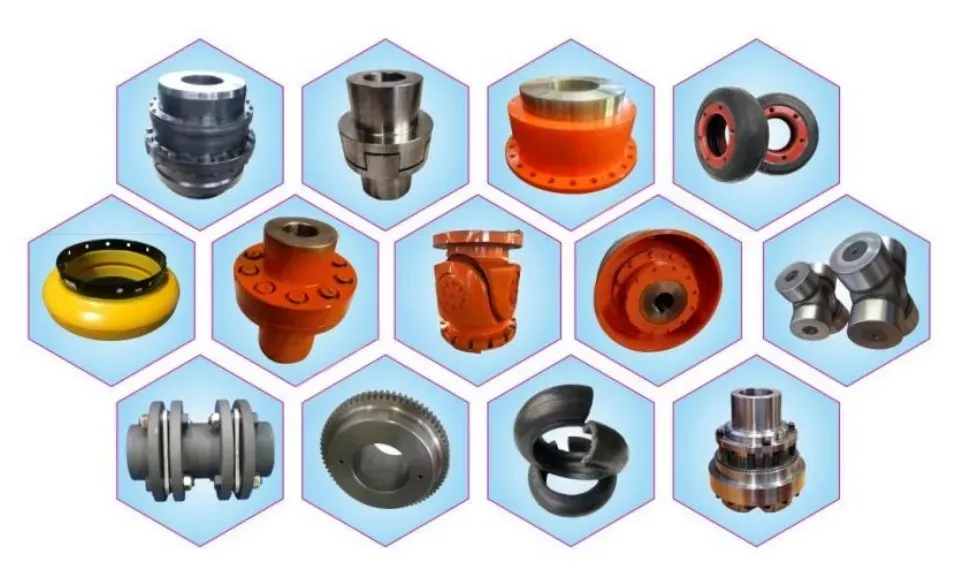
Where the Gear Type Coupling Sits in a Modern Drilling Rig
A modern drilling rig is not a single gear type coupling application — it is several. Each position along the drive chain presents a distinct combination of torque level, speed, misalignment type, and contamination risk. Specifying the same coupling model for every position is a common and costly mistake; the table below maps out the key drive positions and the critical coupling requirement at each.
| Posición de conducción | Function | Critical Coupling Requirement | Typical Torque Range |
|---|---|---|---|
| Prime mover → Gearbox input | Transfers diesel or electric motor output to the rotary transmission | High-speed rating, torsional damping, angular compensation | 5,000 – 30,000 N·m |
| Gearbox output → Rotary table | Final drive to table pinion — highest shock torque, maximum mud exposure | Maximum torque rating, double-seal system, corrosion protection | 50,000 – 300,000 N·m |
| Top drive power swivel | Compensates axial movement as drill string is made up and lowered | Large axial displacement tolerance, continuous rotation | 20,000 – 120,000 N·m |
| Drawworks drum drive | Raises and lowers the entire drill string and BHA | Bidirectional load handling, high torque density, shock resistance | 30,000 – 200,000 N·m |
| Mud pump crankshaft drive | Circulates weighted drilling fluid down the drill string | Pulsating load absorption, chemical resistance in seal compound | 10,000 – 80,000 N·m |
Client Case Study
North Sea Drilling Contractor Eliminates Rotary Coupling Failures: Aberdeen, Scotland
Offshore Platform Operations · Central North Sea Sector, United Kingdom
El desafío
A mid-size offshore drilling contractor operating a semi-submersible platform in the central North Sea sector was experiencing premature failure of the gear type couplings fitted to the output side of the main rotary gearbox. The units were nominally rated at 180,000 N·m, but shock loads during hard-formation drilling at depths beyond 3,500 metres were generating estimated peak torques of 440,000 to 470,000 N·m. Tooth fractures on the coupling hubs were occurring every 900 to 1,100 operating hours, triggering emergency rig shutdowns. Once crew standby costs, footage loss, crane mobilisation, and component replacement were tallied, each unplanned shutdown was costing the operator approximately £175,000 to £195,000. With three or four failures per drilling campaign, the financial impact had become operationally unsustainable.
The Engineering Solution
The operator contacted Ever Power with the rig’s load cycle records, torque history logs from the rig’s monitoring system, and gearbox output shaft drawings. Ever Power’s application engineering team spent three days reviewing the data before issuing a formal technical proposal. The solution was a purpose-engineered gear type coupling manufactured from 18CrNiMo7-6 carburised and case-hardened alloy steel, with an overload torque rating of 540,000 N·m — three times the steady-state operating value. The tooth module was increased from module 6 to module 8, increasing the load-bearing area per tooth. Double-labyrinth seals with EPDM O-rings replaced the original single-lip configuration. A marine-grade NLGI 00 grease formulated for low-temperature offshore service and carrying enhanced corrosion inhibitors was specified as the fill lubricant. The overall coupling envelope matched the original bolt circle and shaft dimensions, so no structural modifications to the gearbox mounting or rig substructure were required.
El resultado
After 26 months and more than 18,400 operating hours on the Ever Power gear type coupling, the operator reported zero tooth failures and zero coupling-related unplanned shutdowns. A maintenance inspection at the 10,000-hour mark confirmed that tooth flank wear remained within the acceptable threshold and that both labyrinth seal faces were free of mud ingress. The operator subsequently standardised the Ever Power custom design across three additional platforms in their North Sea fleet. Across the group, estimated annual maintenance cost savings attributable to the new coupling specification exceeded £420,000 — and that figure does not include the secondary benefits of improved schedule reliability and reduced HSE incident risk associated with emergency rig maintenance in offshore conditions.
What Drilling Engineers and Procurement Managers Say
★★★★★
“We had been replacing couplings on the rotary table drive approximately every ten to twelve months. After specifying the Ever Power gear type coupling, we completed our last North Sea drilling campaign — fourteen months of continuous operation — without a single coupling issue. The sealed labyrinth design makes a substantial difference when you are working in an environment where drilling mud is everywhere. The improvement was immediate and measurable.”
— David R., Senior Drilling Engineer
North Sea Offshore Operations, Aberdeen, Scotland
★★★★★
“Ever Power’s engineering team took our shaft drawings, reviewed two years of our torque monitoring logs, and returned a coupling specification within seventy-two hours. Lead time from order confirmation to delivery on-site was four weeks — remarkably fast for a custom gear type coupling at this torque rating. The unit has been running without fault on our onshore exploration rig in Lincolnshire for well over two years now. We would not hesitate to order again.”
— James T., Rig Superintendent
Onshore Exploration Contractor, East Midlands, United Kingdom
★★★★★
“The price was competitive with other suppliers we evaluated, but what ultimately determined our decision was the technical depth behind the proposal. It was immediately clear that Ever Power understood the difference between nominal torque and peak shock torque in hard-formation drilling — most suppliers simply quote the nameplate rating and leave the safety margin to you. The gear type coupling has performed exactly as specified, and we have subsequently placed orders for our second and third rigs operating in the North Sea.”
— Mohammed A., Group Procurement Manager
International Drilling Services Group (North Sea Project Operations)
Ever Power: Custom Gear Type Coupling Manufacturing for the Oil & Gas Sector
 Standard catalogue products solve standard problems. Oil drilling is not a standard problem — and Ever Power’s manufacturing capability reflects that reality. The production facility operates CNC gear hobbing machines capable of cutting involute teeth to DIN 6 accuracy on hub blanks up to 1,200 mm in diameter. The carburising and case-hardening line accommodates finished component weights up to 800 kg, with temperature-controlled furnace cycles that hold case depth and surface hardness to the tight tolerances required for high-shock drilling service. Finished assemblies are inspected on a coordinate measuring machine (CMM) and balanced dynamically before despatch. This is a manufacturer with full process control from raw-steel forging to finished, documented assembly — not a distributor adding a nameplate to a generic product.
The custom design service for drilling rig gear type couplings covers every engineering variable that matters in this application: bore diameter and keyway geometry to suit any shaft standard including DIN, AGMA, API, and JIS; tooth module and flank profile adjusted to the specific torque-shock service factor of the customer’s rig and formation type; material upgrade paths from standard 42CrMo4 through to fully carburised 18CrNiMo7-6 for maximum peak load capacity; seal selection matched to the contamination environment — drilling mud, salt spray, solvent-based treatment fluids; surface coating options including nickel plating and high-velocity oxygen-fuel (HVOF) tungsten carbide spray for extreme corrosion duty; and full documentation packages meeting DNV-GL, API, and ATEX requirements as applicable to the installation location.
For UK-based operators — whether your operations are in the central or northern North Sea sector, the Irish Sea, the Weald Basin exploration licences in Sussex and Hampshire, or onshore sites in Yorkshire and Lincolnshire — Ever Power supplies gear type couplings with full documentation compatible with UK Health and Safety Executive (HSE) requirements and the UKCS safety case framework. Material traceability certificates, dimensional inspection reports, and heat treatment records are issued as standard with every order. Lead times for standard-range units are typically two to three weeks; fully custom-engineered assemblies require four to eight weeks depending on complexity and current production scheduling.
Preguntas frecuentes
Ready to Specify the Right Gear Type Coupling for Your Drilling Rig?
Whether you are retrofitting an ageing onshore rig in Yorkshire, commissioning a new rotary table drive on a central North Sea platform, or replacing a failed coupling under schedule pressure, Ever Power’s application engineering team is ready to respond. Send your shaft dimensions, torque requirements, and operating conditions and receive a full, costed technical proposal within 24 to 48 hours — no obligation.
📩 Get a Quote · [email protected]
UK & International Enquiries · Custom Engineering Available · Fast Lead Times · Offshore Documentation on Request · edit by gzl