Description
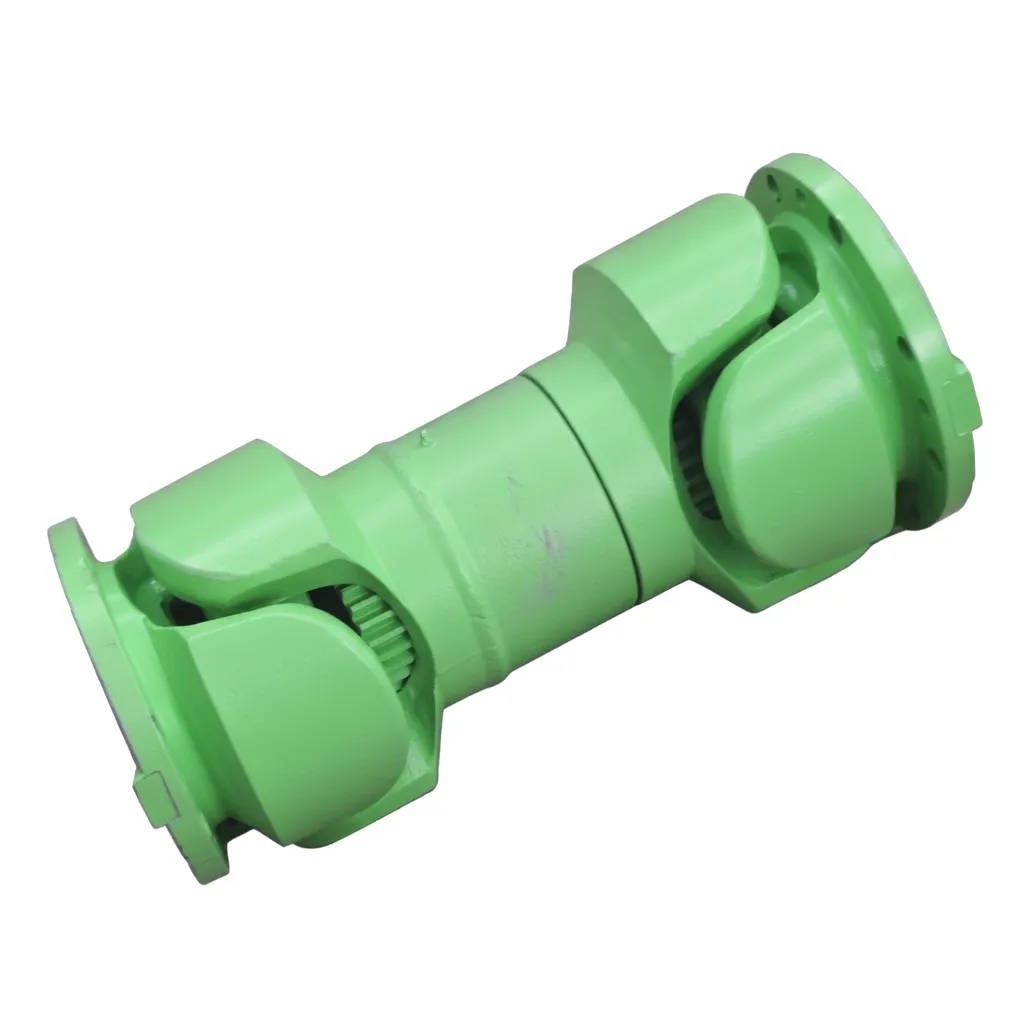 There is a quiet but critical component inside nearly every rolling mill, continuous caster, and industrial hoist operating across the United Kingdom today. It does not announce itself. It does not require operator attention every shift. Yet without it, thousands of tonnes of torque would have nowhere to go, and the heavy steel shafts at the heart of Britain’s most demanding manufacturing lines would grind apart in a matter of hours. That component is the SWC-DH short flex welding type universal joint coupling — and understanding it properly is the difference between a maintenance strategy built on guesswork and one built on engineering precision.
This guide is written for plant engineers, procurement managers, and technical directors across the UK who need more than a product brochure. It draws on real field behaviour, dimensional data, material science, and application logic accumulated across more than eighteen years of working directly with power transmission systems in some of the most punishing industrial environments in Europe. If you are specifying a universal joint coupling for a new installation, replacing a worn-out component, or simply trying to understand why your current coupling is underperforming, this is the resource you need.
The SWC-DH coupling is not a generic product. It belongs to a specific engineering category — the short-flex, welded-end universal joint — that is purpose-built for applications where shaft misalignment is a permanent operating condition rather than an installation error. Rolling mills in Sheffield, ore processing plants in South Wales, and paper manufacturing lines in the Scottish Highlands all share a common challenge: connecting rotating shafts that are never perfectly in line. The SWC-DH was designed from the ground up to handle exactly this reality.
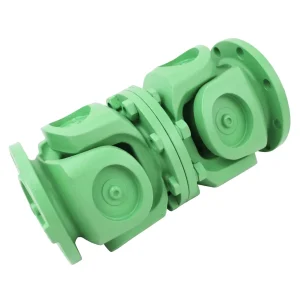
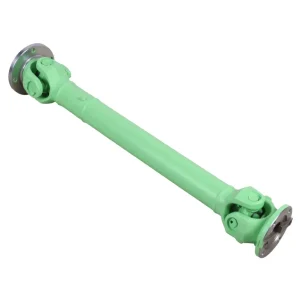
SWC-DH Short Flex Welding Type Universal Joint Coupling — industrial torque transmission rated up to 250 kN·m
What Exactly Is the SWC-DH Universal Joint Coupling?
The designation “SWC-DH” follows Chinese national standard GB/T 5901, which defines the geometry, load rating, and interchangeability specifications for this family of universal couplings. The suffix “DH” indicates a short-flex variant with welded shaft ends — meaning that instead of a bolted flange connection, the coupling yokes are designed to be directly welded onto the connected shafts. This seemingly small design choice has major implications for mechanical integrity. Welded connections eliminate the possibility of bolt loosening under vibration, remove potential failure points at the flange interface, and distribute load more evenly across the shaft cross-section.
Mechanically, the coupling consists of two identical yoke assemblies connected through a central cross-shaft (also called a spider or trunnion). Each arm of the cross-shaft runs inside a needle bearing housed within the yoke lug bores. The needle bearings — rather than bush bearings or plain journals — are the reason this coupling can tolerate both continuous rotation and angular misalignment without generating destructive heat or excessive friction losses. Needle bearings offer a very high load-to-contact-area ratio, which is precisely why they are preferred in heavy-duty universal joints where radial loads are large and envelope space is limited.
The “short flex” characteristic refers to the coupling’s axial float capacity — the amount by which the overall length can compress or extend under operating loads. Unlike longer-bodied sliding-spline couplings, the SWC-DH provides limited axial movement (the “Ls” or flex quantity listed in its specification tables), which makes it ideal for installations where shaft axial wandering must be tightly controlled, such as the drive spindles feeding rolling mill stands. By constraining axial movement while still accommodating significant angular misalignment — up to 25 degrees on the SWC180DH variants — the design strikes exactly the right balance for continuous industrial process lines.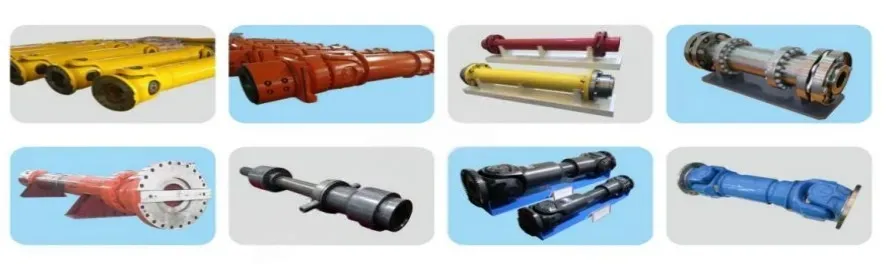
SWC-DH Universal Coupling — Key Technical Parameters
The table below summarises the principal dimensional and performance data across the full SWC-DH size range. Engineers should note that Lmin values represent the minimum installed length after trimming, and that rotating inertia figures are given at Lmin for each variant. Weight increases at 100 mm increments are also provided to assist in structural support calculations.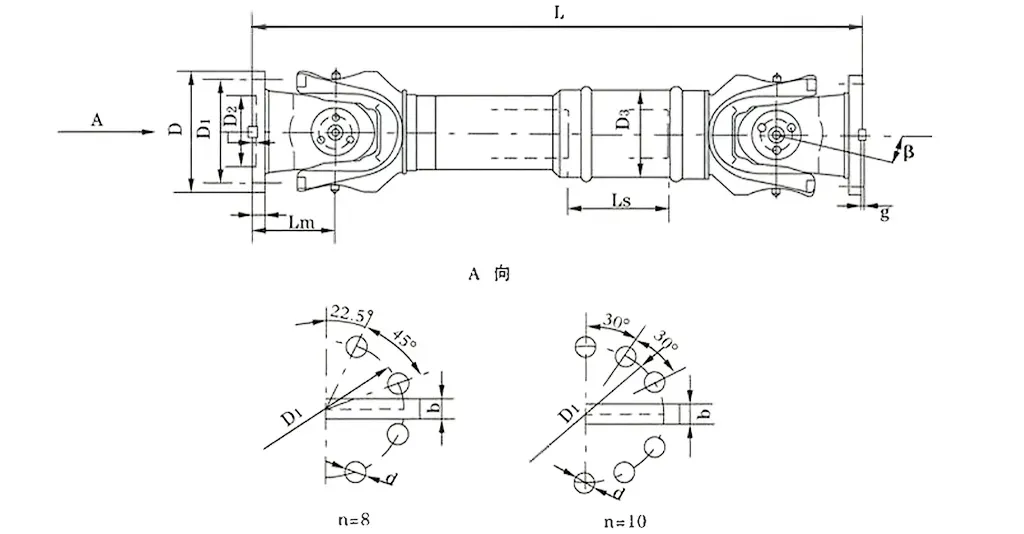
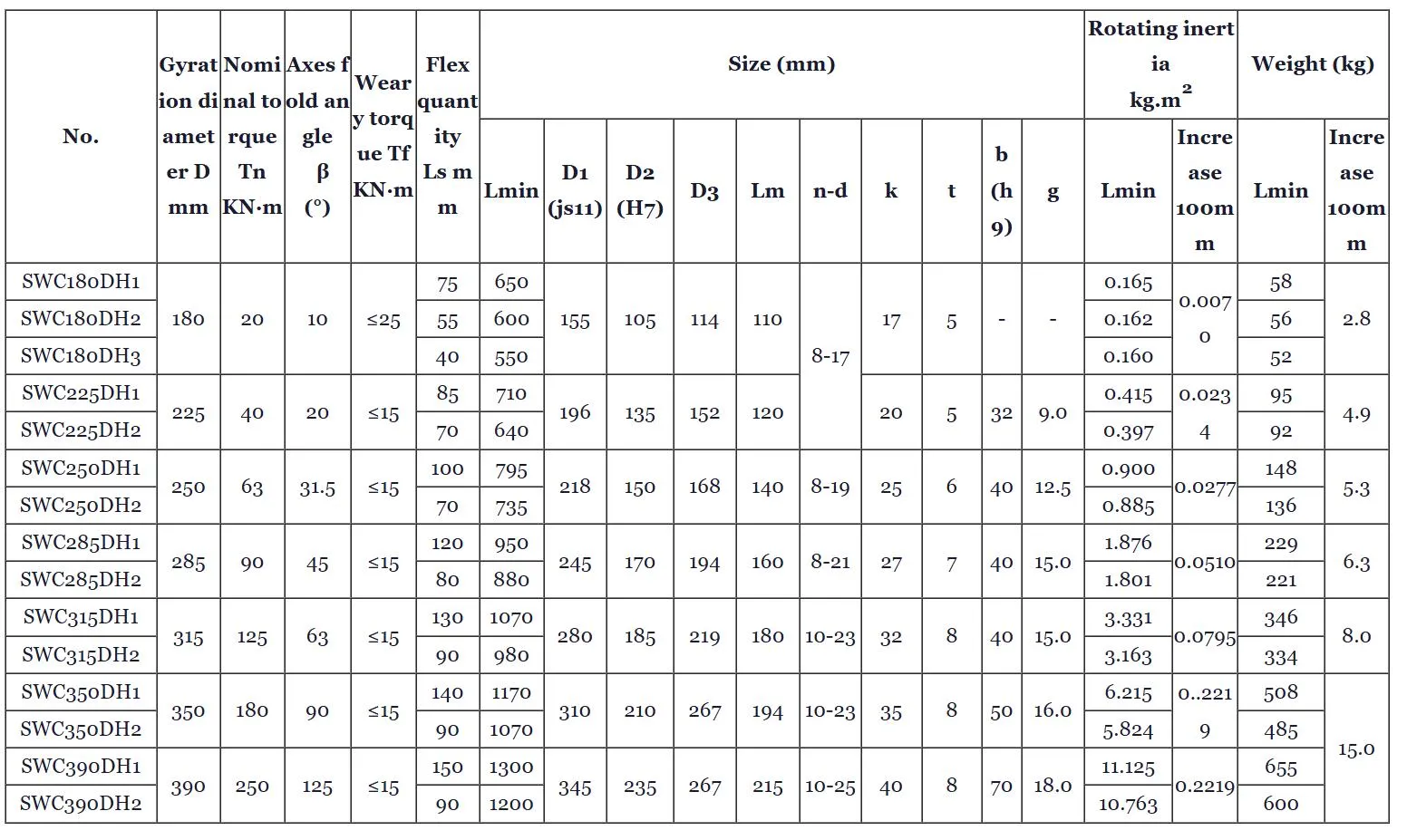
* Tf = fatigue torque under alternating load. Lmin = minimum length after trimming. All figures per GB/T 5901 standard.
SWC-DH dimensional drawing — D1, D2, D3, Lmin, Lm and bolt circle reference points
Five Engineering Reasons UK Plant Managers Specify the SWC-DH
Short-Flex Architecture for Confined Layouts
In rolling mill bay designs, the inter-stand distance is fixed by the pass schedule, not by the coupling manufacturer’s convenience. The short-flex design of the SWC-DH coupling means that the overall assembly length can be trimmed precisely to fit the available space between the drive gearbox output flange and the roll spindle sleeve. This eliminates the need for intermediate shaft extensions or adapter plates that introduce additional failure points. The result is a cleaner, stiffer driveline that behaves more predictably under cyclic torque reversals — exactly what happens at every bite engagement in a hot strip mill.
Angular Misalignment Tolerance Up to 25°
The SWC180DH variants handle angular misalignment of up to 25 degrees — an extraordinary figure for a coupling of this torque class. Larger diameter SWC-DH models operate at up to 15 degrees, which still far exceeds the 3–5 degree limit typical of gear couplings. This means that even when mill housings shift, foundations settle, or thermal expansion displaces shaft centrelines during production, the universal joint coupling continues transmitting torque without generating the bending moments and radial forces that destroy bearings in misaligned rigid-coupling installations. For UK steel and aluminium processing sites, this tolerance is not a luxury — it is the difference between planned maintenance and emergency downtime.
Rated Torque Capacity Up to 250 kN·m
The largest SWC-DH variant — the SWC390DH series — carries a nominal torque rating of 250 kN·m, with a fatigue torque rating of 125 kN·m under alternating load cycles. To put that in physical terms, 250 kN·m is the equivalent of roughly 184,000 foot-pounds — enough to drive the primary reduction stage of a 12,000 kW hot rolling drive. The fatigue torque specification is particularly relevant for UK applications such as wire rod mills and section mills, where torque reversals occur thousands of times per shift as bars enter and exit each rolling stand. A coupling dimensioned only to peak torque, without considering fatigue endurance, will fail prematurely in these conditions.
Welded Shaft Connection Eliminates Bolt Fatigue
Flanged universal couplings fail at their bolts. It is a pattern seen repeatedly on UK mill sites — bolts stretch under torsional shock loading, the preload drops, relative micro-movement begins, fretting corrosion develops, and within weeks the flange is leaking and the coupling is transmitting torque eccentrically. The SWC-DH avoids this entirely by using a welded connection. Once properly welded by a qualified fabricator following the manufacturer’s joint preparation specification, the coupling becomes mechanically integral with the shaft — there are no bolted interfaces to loosen, no fretting surfaces to corrode, and no periodic retorquing intervals to manage. For remote industrial sites in the Scottish Highlands or Welsh valleys where maintenance access is limited, this is a meaningful operational advantage.
Standard Range Covering Every Common UK Industrial Drive Size
With gyration diameters from 180 mm through 390 mm and torque ratings from 20 kN·m to 250 kN·m, the SWC-DH standard range covers the vast majority of rotating machine drive applications encountered in UK heavy industry. Whether you are maintaining a legacy 1970s hot strip mill in the Black Country, commissioning a new continuous galvanising line in the East Midlands, or specifying drive components for a port crane upgrade on the Humber, there is a standard SWC-DH size that will map directly onto your driveline geometry without expensive custom engineering. And for the cases where standard dimensions genuinely do not fit — custom variants are available. More on that in the factory section below.
How the SWC-DH Universal Joint Coupling Works: Principle & Materials
Torque Transmission Mechanism
When a motor drive rotates the input shaft of an SWC-DH universal joint coupling, the input yoke rotates with it. The yoke lugs engage the two bearing journals of the cross-shaft that lie in the driving plane. These journals transmit force through their needle bearings to the cross-shaft body, which in turn loads the two driven-plane journals. The driven-plane journals act on the output yoke lugs, transmitting rotation to the output shaft. Because the cross-shaft can pivot freely within both sets of bearing journals simultaneously, the entire assembly can accommodate the angle between the two shaft axes — the coupling’s fundamental geometric trick. At any given angular position, the velocity ratio between input and output is not perfectly constant (a known characteristic called “Hooke’s joint velocity variation”), but in most rolling mill and hoist applications this second-order effect is negligible and the coupling operates as a near-constant-velocity device.
Material Specification
The yoke forgings in SWC-DH couplings are produced from alloy structural steel — typically 42CrMo4 or equivalent, a medium-carbon chromium-molybdenum alloy that combines high tensile strength (up to 1,100 MPa) with excellent fatigue resistance and good weldability when processed correctly. After forging, yokes are heat-treated to a specific hardness band that balances toughness (resistance to impact and shock) with strength (resistance to yield under sustained load). The cross-shaft is typically manufactured from case-hardening steel such as 20CrMnTi, which provides a hard, wear-resistant surface layer over a tough core — essential for the journal surfaces where needle bearings run. Needle bearings themselves are produced from high-chromium bearing steel (GCr15 equivalent to 100Cr6), hardened to 60–64 HRC for maximum contact fatigue life.
Lubrication & Sealing
Each needle bearing journal in the cross-shaft assembly is equipped with a grease nipple and an internal lubricant distribution passage. Standard industrial grease (NLGI Grade 2, lithium-complex based) is introduced at commissioning and replenished at scheduled intervals — typically every 500 to 1,000 operating hours depending on speed and operating angle. Lip seals or labyrinth seals protect the bearing bores from mill scale, water mist, and abrasive contamination that are endemic in UK hot-rolling environments. The quality of this sealing arrangement is a key differentiator between couplings that last three years and those that are replaced every six months — a detail worth verifying with any potential supplier before ordering.
Where SWC-DH Universal Joint Couplings Are Used Across UK Industry
🔥 Hot Rolling Mills
The primary application. SWC-DH couplings connect main drive gearboxes to the roll spindles in roughing and finishing mill stands. The combination of high torque capacity and misalignment tolerance handles the continuous angular change as rolls wear and are repositioned during campaign changes. UK steel producers in Scunthorpe, Port Talbot, and Rotherham routinely specify SWC-DH variants for both primary and secondary drive positions.
⚓ Port & Marine Hoists
Ship-to-shore cranes and harbour mobile cranes at UK ports — Felixstowe, Southampton, Tilbury, and Liverpool — use SWC-DH couplings in hoist drum drive trains. The angular flexibility accommodates the slight misalignment that develops as crane structures flex under load, while the welded shaft connection withstands the shock loading generated when a container is suddenly arrested by a snagged lashing.
⛏️ Mining & Mineral Processing
Gyratory crushers, ball mills, and conveyor head drives in UK quarrying operations and mineral processing plants (particularly in Cornwall, Derbyshire, and South Wales) impose severe shock and misalignment simultaneously. SWC-DH couplings at these installations are often specified with enhanced sealing to cope with the abrasive dust environments that would destroy standard bearing seals in a matter of weeks.
📄 Paper & Pulp Manufacturing
Wet-end press section drives and dry-end calendar drives on paper machines must maintain precise torque balance between drive sections separated by significant angular offsets. SWC-DH couplings at mills in Scotland and the North West of England provide the combination of angular flexibility and torque capacity needed, while the sealed needle bearing design resists the water and chemical vapour present in these humid environments.
Customer Success: South Wales Hot Strip Mill Reduces Coupling Failures by 78%
Case Study · UK Steel Industry · 2022–2024
Background
A major integrated steel producer operating a hot strip mill in South Wales was experiencing chronic drive coupling failures at stands F3 and F4 of their seven-stand finishing mill. The existing gear-type couplings were failing every four to six months, typically via tooth breakage or flange bolt fatigue. Each failure required a 14-hour mill stoppage for coupling removal, replacement, and shaft realignment — at a production cost exceeding £180,000 per incident.
Root Cause & Solution
A detailed root cause analysis revealed that the gear couplings were being operated at 8–10 degrees of continuous misalignment due to housing settlement and thermal growth — well beyond the 3-degree design limit of the gear coupling. The plant’s engineering team, in consultation with our application engineers, specified SWC-DH285 couplings for both stands, rated to 90 kN·m nominal and capable of 15 degrees of sustained misalignment. The welded shaft connection was used to eliminate the previous issue of flange bolt failures. Couplings were installed during the next scheduled furnace relining outage — no additional downtime was required for the coupling change.
Results After 24 Months
What UK Industrial Engineers Say
We switched three drive stands over to SWC-DH couplings during our summer shutdown. Fourteen months later, we have not touched them once. For a site like ours where unplanned downtime costs six figures, that kind of reliability is genuinely transformative. The welded connection was new to our maintenance team, but the installation guidance was clear and the result speaks for itself.
Our ball mill drive has a permanent 11-degree angular offset because of the way the structure was built in the 1980s — it was never corrected because it would have meant a six-week plant shutdown. The SWC-DH couplings handle that offset without complaint. We have gone from quarterly replacements to annual inspections with no failures. The fatigue torque rating gave us the confidence to push harder during peak production periods.
I was sceptical about the welded connection at first — our team was used to flanged couplings and I worried about the weld quality in our fabrication shop. The manufacturer provided detailed weld procedure specs and we had the first set done under supervision. The welds came out excellent and the couplings have been running for two full years now without any issues. The lead time was surprisingly short for a product of this complexity.
Manufacturing Capability & Custom Engineering Services
The manufacturing facility behind the SWC-DH product range holds ISO 9001:2015 certification and operates CNC gear hobbing, precision forging, and automated heat treatment lines that ensure dimensional consistency across every production batch. CAD-based design tools are used throughout the engineering process, and every critical dimension is verified against the GB/T 5901 standard before assembly begins. The facility exports to Germany, the United States, Japan, the United Kingdom, Australia, and Singapore — which means that lead times to UK distributors and end users are well-established and predictably short.
Where standard SWC-DH dimensions do not match your installation geometry, our engineering team offers a genuine custom design service. This is not simply resizing an existing model — it encompasses full FEA-backed stress analysis, modified yoke geometry, non-standard flange bore configurations, alternative sealing arrangements for extreme environments, and special surface treatment options (including hot-dip galvanising, epoxy coating, or nickel plating for corrosive environments). We have successfully delivered replacement couplings for legacy OEM machines where the original manufacturer no longer supports the product. If you have a drawing or a worn-out sample, our engineers can reverse-engineer and manufacture a direct replacement, often within half the lead time you would get from the original equipment manufacturer.
Custom Engineering Scope
✔ Extended or shortened Lmin
✔ High-angle variants (beyond 25°)
✔ Marine-grade surface treatment
✔ Integrated torque limiters
✔ OEM cross-reference replacement
✔ Split-yoke maintenance designs
✔ Rapid supply for emergency breakdowns
SWC-DH Universal Joint Couplings — Supply & Support Across the United Kingdom
Procurement teams and maintenance planners across the UK’s major industrial regions — including the steel-producing centres of South Yorkshire, the North East, and South Wales, the mining and quarrying operations in Derbyshire, Cornwall, and Cumbria, the heavy engineering clusters of the West Midlands, and the port and marine facilities in Southampton, Liverpool, Felixstowe, and on the Humber — can access SWC-DH coupling stock and technical support through our established UK supply network. Standard SWC180 through SWC350 variants are typically held in stock for rapid despatch. Larger SWC390 and custom configurations are manufactured to order with lead times that are confirmed at quotation stage — typically 4 to 8 weeks for standard custom variants, and 8 to 14 weeks for complex engineering projects.
Technical application support is available to UK engineers at any stage of a project — from initial specification through installation, commissioning, and in-service troubleshooting. If you are preparing a capital equipment specification, replacing a failed coupling in an emergency, or benchmarking the SWC-DH against an existing product, our application engineers can provide dimensional drawings, material certificates, test reports, and product selection guidance. Contact us directly to discuss your specific UK installation requirements and receive a tailored recommendation.
Frequently Asked Questions
What is the best universal joint coupling for a hot rolling mill drive in the UK where shaft misalignment exceeds 10 degrees continuously?
For continuous misalignment beyond 10 degrees in a hot rolling mill drive, the SWC-DH short flex welding type universal joint coupling is the most appropriate solution. Unlike gear couplings, which are typically limited to 3–5 degrees, or flexible disc couplings, which are designed for very low misalignment with high angular stiffness, the SWC-DH can accommodate sustained angular offsets of up to 15 degrees (on SWC225 and above) and up to 25 degrees on SWC180 variants. The welded shaft connection eliminates bolt fatigue — the leading cause of coupling failure in shock-loaded rolling mill drives. For stands operating at more than 10 degrees of continuous offset, we recommend the SWC285DH or SWC315DH depending on your torque requirement, and we can provide a full application engineering review free of charge before you order.
How much does an SWC-DH universal joint coupling cost, and can I get a price quote for a replacement in my UK plant?
Pricing for SWC-DH universal joint couplings varies based on the model size, the Lmin dimension selected, and whether the installation requires standard or custom engineering. Smaller SWC180 variants are considerably less expensive than SWC390 models, and custom configurations carry additional engineering charges. The most efficient way to get an accurate price for your UK installation is to contact our team directly at [email protected] with your model reference, the required Lmin dimension, and the quantity needed. We aim to respond to all UK quote requests within one working day, and for emergency replacements we can often fast-track both the quotation and the supply process.
Where can I find a reliable supplier of SWC-DH short flex welding type universal couplings for heavy industry in the United Kingdom?
Reliable UK supply of SWC-DH couplings requires a supplier with ISO 9001 certified manufacturing, full dimensional traceability to GB/T 5901, and the ability to provide material certificates upon request — especially important for UK plant owners maintaining PSSR (Pressure Systems Safety Regulations) and Machinery Directive compliance documentation. Our company supplies SWC-DH couplings directly to UK industrial users with stock availability on standard sizes and factory-backed technical support. We have supplied to plants in South Yorkshire, South Wales, Derbyshire, Scotland, and the Greater London logistics corridor. Contact us for availability and logistics details specific to your site.
How do I select the correct SWC-DH model size for my UK rolling mill application when I know the drive motor power and shaft speed?
The starting point is calculating the nominal transmitted torque: T = (9550 × P) / n, where P is motor power in kilowatts and n is shaft speed in rpm. This gives you the torque in Newton-metres. You then apply a service factor based on application type — for rolling mill stands with frequent shock loading, a service factor of 1.5 to 2.0 is typical. Compare your factored torque against the Tn (nominal torque) values in the SWC-DH selection table, and select the smallest model whose Tn exceeds your factored requirement. You should also check the fatigue torque Tf against your cyclic load conditions and confirm that your angular misalignment falls within the β specification for that model. Our engineering team is happy to perform this selection calculation for you — contact us with your motor plate data and we will return a recommended model with full justification.
What is the recommended maintenance interval for SWC-DH universal joint couplings operating in UK steel mills or mining plants?
Under typical UK heavy industrial conditions — continuous operation at 50–70% of rated torque, moderate shock loading, and ambient contamination from mill scale or mineral dust — SWC-DH couplings should be inspected and relubricated every 500 to 1,000 operating hours. At each service, check for visible cracks in the yoke arms, measure radial play in the cross-shaft bearing journals (replace if play exceeds 0.15 mm), inspect lip seals for condition, and replenish grease through the cross-shaft nipples until fresh grease emerges from the relief. Couplings operating at angles above 10 degrees continuously should be inspected more frequently — every 300 to 500 hours — as needle bearing wear accelerates with operating angle. Full coupling replacement is typically indicated at the 30,000-hour mark or when bearing journal wear exceeds limits, whichever comes first.
Can the SWC-DH universal coupling be custom engineered to replace an obsolete OEM coupling in a legacy UK industrial machine?
Yes — this is one of the most common requests we receive from UK plant engineering teams managing ageing equipment. If you have the original OEM coupling drawing, a worn sample, or even just the key dimensions (yoke bore diameter, overall length, PCD, and bolt pattern if flanged), our engineering team can design an SWC-DH equivalent that matches your installation geometry while meeting or exceeding the original torque capacity. We have successfully replaced couplings from German, Japanese, and American OEMs for UK customers across the steel, mining, and paper industries. Non-standard shaft diameters, unusual Lmin values, and modified yoke angles are all within our manufacturing capability. Send your drawing or sample details to [email protected] to start the process.
Which SWC-DH universal joint coupling variant is most suitable for a hoist drum drive at a UK port operating in a marine salt atmosphere?
For UK port crane and hoist drum applications in marine atmospheres — such as those found at Felixstowe, Southampton, Liverpool, or the Tyne — we recommend specifying the SWC-DH variant with our enhanced marine sealing package and hot-dip galvanised yoke surface treatment, combined with a stainless-steel cross-shaft option. The model size depends on the hoist motor power and drum speed, but SWC225DH and SWC285DH variants cover the majority of standard port crane hoist drive requirements. The enhanced sealing prevents salt-laden moisture ingress that would otherwise rapidly corrode the needle bearing journals. We can also supply stainless-steel grease nipples and corrosion-resistant retaining hardware as part of a complete marine-specification assembly. Contact our team for a full marine-environment specification review and pricing tailored to your specific port location and crane model.
Ready to Specify the Right Universal Joint Coupling for Your UK Application?
Our application engineers are available to assist UK procurement and maintenance teams with model selection, dimensional drawings, material certificates, and emergency supply. Send your enquiry today and receive a detailed technical response within one working day.
[email protected] · UK enquiries responded to within 1 business day
edit by gzl