Continuous casting — the process by which liquid steel is solidified into semi-finished slabs, blooms, or billets — sits at the absolute core of modern steelmaking. Across the UK, from Port Talbot to Scunthorpe, continuous casting machines (CCMs) operate around the clock under punishing conditions: extreme heat, aggressive water spray cooling, colossal mechanical loads, and the relentless demand for dimensional accuracy in the finished product. Within these machines, the drive system that pulls the solidifying strand through the mould and straightening rolls is only as reliable as the couplings that transmit power along the entire drivetrain.
The gear type coupling has emerged over decades as the go-to power transmission solution for CCM strand guide rolls, mould oscillation drives, and cutting machines — for reasons that go far beyond simple engineering convention. When you study the precise demands of a continuous casting environment and map them against what a properly specified gear coupling can deliver, the selection logic becomes crystal clear. This article draws on 18 years of hands-on application engineering experience to give plant engineers, maintenance managers, and procurement teams a definitive guide to gear type coupling selection for continuous casting machine drive systems.
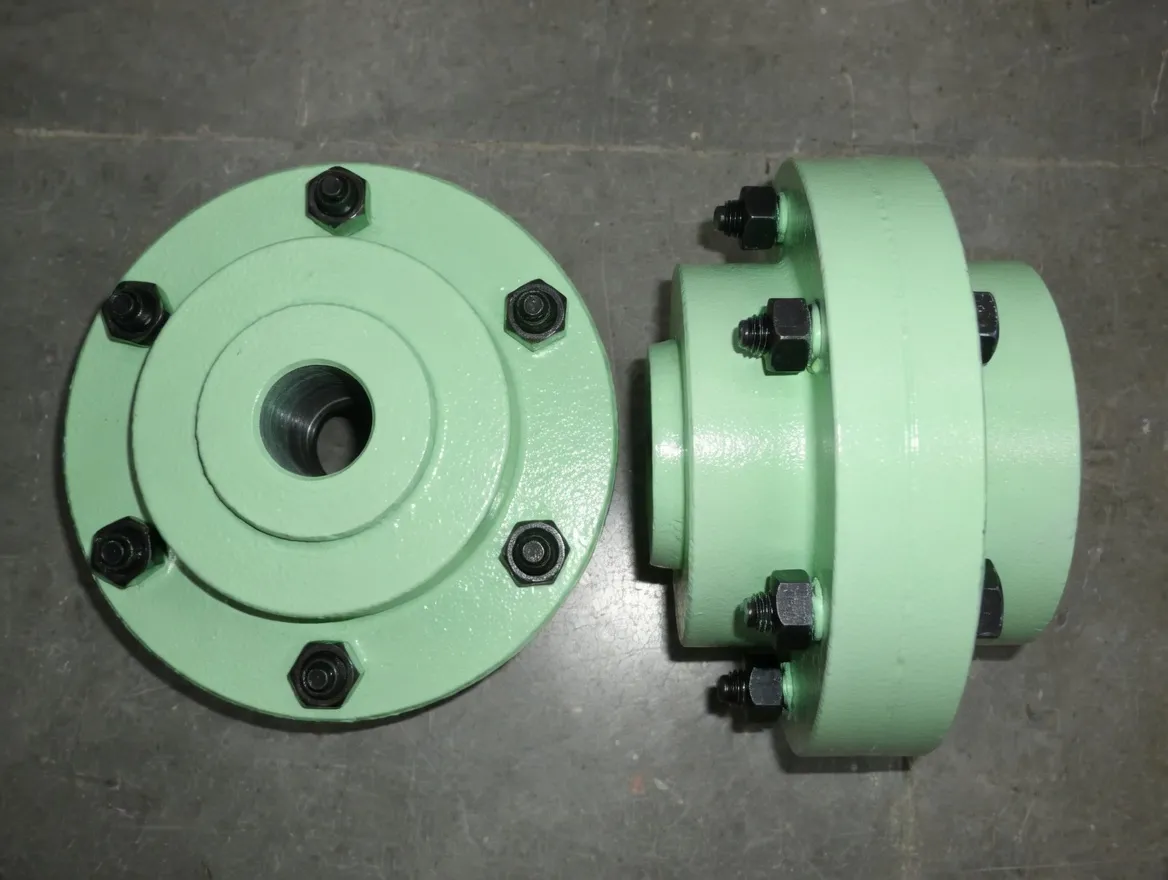
Ever Power heavy-duty gear type coupling installed on continuous casting strand guide roll drive — designed for high torque, thermal compensation, and harsh plant environments.
Why Continuous Casting Machine Drives Push Every Coupling to Its Limit
To understand why the gear type coupling dominates this application, you first need to appreciate just how hostile a continuous casting machine environment really is. The strand guide section — also called the secondary cooling zone — subjects every mechanical component to a brutal combination of stresses that would challenge even the most conservatively-rated equipment. Steel temperatures at the mould exit typically range from 1000°C to 1200°C. Water spray cooling creates a permanent mist that infiltrates every unsealed cavity. The support rolls themselves heat up significantly during operation, causing thermal growth across the entire roll body and its connecting shaft, which means that the drive coupling must accommodate shaft misalignment that changes dynamically throughout each cast.
On top of the thermal challenge, the mechanical loads are severe. The friction resistance generated as the solidifying strand is pulled through a typical slab caster can reach tens of thousands of Newton-metres across the full strand guide. Individual roll segments must be capable of absorbing shock loads when the strand speed is changed, when a breakout event occurs, or simply when the lead end of a new charge passes through the segment. These shock torque spikes — which can briefly exceed 200% of rated running torque — must be absorbed and transmitted without fatigue failure in the coupling. Additionally, the mould oscillation mechanism imposes high-frequency cyclic loading that demands exceptional fatigue resistance from every drive component, including the gear coupling.
The Engineering Advantages of Gear Type Couplings in CCM Applications
Исключительная плотность крутящего момента
The gear mesh design of a gear coupling transmits torque through multiple tooth contacts simultaneously, producing a torque-to-weight ratio that no jaw or disc coupling can match at the same shaft diameter. This is decisive in CCM strand guide drives where roll shaft diameters and inter-roll spacing constrain envelope dimensions, yet torque requirements are very high.
Angular & Radial Misalignment Tolerance
The crowned gear tooth profile is the key feature that sets gear couplings apart in thermal-displacement environments. As the strand guide rolls expand under heat, the coupling absorbs the resulting shaft misalignment — both angular and parallel — without imposing bending moments on the motor shaft or gearbox output. Well-designed units tolerate angular misalignment up to 1.5° per mesh, sufficient for most CCM operating conditions.
All-Metal Construction for Hostile Environments
Unlike elastomeric or polyurethane-element couplings, the gear type coupling contains no rubber or polymer components that would degrade under thermal radiation, steam, and lubricant contamination. Hub and sleeve materials are typically alloy steel with carburised and ground gear teeth, providing both high fatigue strength and the hardness necessary to resist wear under the cyclic loading imposed by mould oscillation drives.
Sealed & Lubricated for Extended Service Life
Modern gear couplings for steel plant service use sealed designs with high-temperature, water-resistant grease retained by robust lip seals or labyrinth-type seals. This is non-negotiable in a CCM environment where the water spray cooling system creates a permanent high-pressure mist. A properly sealed gear coupling in a CCM strand guide application regularly achieves 12-to-18-month service intervals without relubrication, dramatically reducing planned maintenance cost.
Compact Installation Footprint
CCM strand guide segments are densely packed, particularly in the lower sections of a curved machine. The gear type coupling’s compact radial envelope means it can be fitted within tight roll-to-roll pitch spacings that would make a disc pack or bellows coupling physically impossible to install. This compactness advantage frequently makes the gear coupling the only viable choice — not just the preferred one.
Proven Fatigue Resistance Under Reversing Loads
Mould oscillation systems reverse direction up to 200 times per minute at certain casting speeds. The gear mesh in a quality gear coupling — when correctly dimensioned for the reversing torque spectrum — handles this cyclic loading through the structural integrity of its alloy steel teeth rather than relying on any elastomeric element that would fatigue over time. This is a core reason why gear couplings remain the specified solution for oscillation drive systems at major UK steel plants.
Technical Performance Parameters — CCM-Grade Gear Type Couplings
The table below summarises the principal design and performance parameters for the Ever Power gear type coupling range as applied to continuous casting machine strand guide and mould oscillation drives. Custom sizes and material specifications outside these ranges are available on request — see the factory customisation section below.
| Параметр | Стандартный диапазон | CCM Strand Guide | Mould Oscillation |
|---|---|---|---|
| Rated Torque (Nm) | 250 – 2,500,000 | 10,000 – 800,000 | 2,000 – 120,000 |
| Max Angular Misalignment | До 1,5° на сетку | 0.5° – 1.0° | 0.3° – 0.8° |
| Осевое смещение (мм) | ±1 – ±15 | ±3 – ±12 | ±1 – ±5 |
| Gear Tooth Material | 20CrMnTi / 42CrMo4 | 42CrMo4 carburised | 20CrMnTi hardened |
| Твердость поверхности зуба (HRC) | 56 – 62 | 58 – 62 | 56 – 60 |
| Operating Temperature Range | от -20°C до +120°C | +40°C to +110°C | +20°C to +90°C |
| Seal Type (CCM duty) | Lip seal standard | Labyrinth + lip seal | Double lip seal |
| Тип смазки | Смазочная/масляная ванна | EP grease, sealed-for-life option | EP grease, sealed |
| Shock Load Capacity | Up to 2× rated torque | Up to 2.5× rated torque | Up to 2× rated torque |
| Recommended Relubrication Interval | 6 – 12 months | 12 – 18 months (sealed) | 6 – 12 months |
Gear Type Coupling Application Scenarios Within the Continuous Casting Machine
A modern slab or bloom continuous casting machine contains multiple distinct drive systems, each placing different demands on its coupling. Understanding these differences is important when specifying or sourcing replacement gear couplings for a UK steel plant or for new-build CCM equipment.
1. Strand Guide Roll (Pinch & Straightening Rolls)
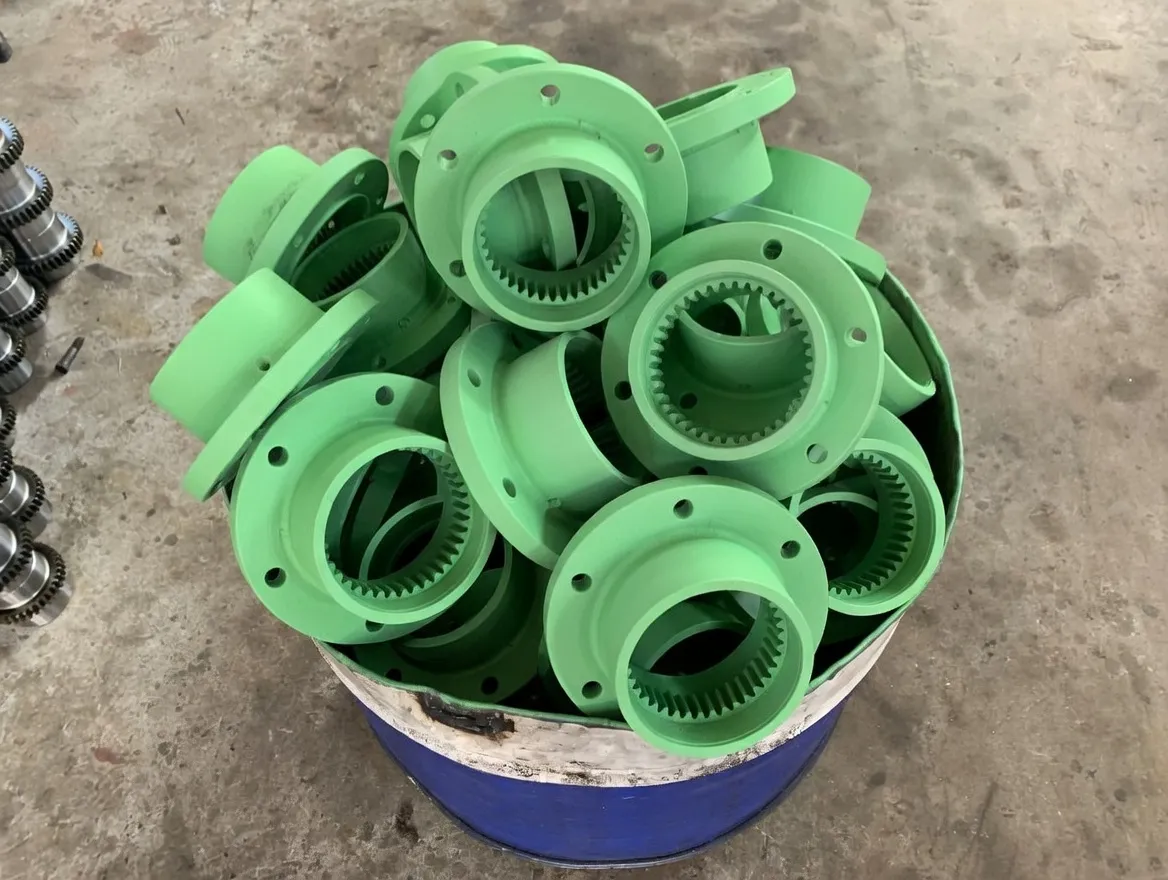
This is the most demanding gear coupling application in a CCM. Each driven roll must transmit high torque through a coupling that can tolerate both thermal shaft growth and the deflection of the roll body under strand load. Gear type couplings rated to 800,000 Nm are used in wide slab casters, with double-engagement designs to achieve the required combined angular and axial compensation. Ever Power supplies these units with forged alloy steel hubs, carburised and precision-ground crowned teeth, and a sealed labyrinth design that keeps water spray out of the grease cavity even under high-pressure cooling.
2. Mould Oscillation Drive
The mould oscillation mechanism moves the copper mould in a sinusoidal or non-sinusoidal pattern — typically at frequencies between 1 and 4 Hz — to prevent the solidifying steel from sticking to the mould walls. The coupling between the oscillation motor/gearbox and the eccentric drive shaft must handle continuous load reversals without backlash-induced shock or fatigue damage. Gear couplings are specified here because their all-metal construction gives consistent behaviour over tens of millions of load cycles, whereas elastomeric couplings would require replacement every few months under such duty.
3. Torch Cutting Machine Drive
The torch cutting machine must travel with the moving strand at precisely matched speed during the cutting cycle, then return rapidly to its starting position. This creates a duty cycle of moderate torque at running speed followed by rapid reversals and brief periods of high acceleration torque. The gear coupling in this application needs to accommodate small misalignments from the cutting machine’s linear guide system while transmitting the required torque reliably and without contributing to positional inaccuracy in the cut-to-length system.
4. Withdrawal & Straightening Unit
Curved CCM machines include a straightening unit that bends the partially solidified strand from the casting radius to a horizontal exit direction. The bending forces here are very high, and the drive rolls in the straightening unit are subject to massive reaction forces from the strand. Gear type couplings in this zone must cope with a combination of high torque, significant angular misalignment as the machine flexes, and the vibrational loads associated with straightening a non-uniform strand profile. Custom-engineered double-engagement gear couplings from Ever Power are the standard solution for this application.
How a Gear Type Coupling Works — Materials and Operating Principle
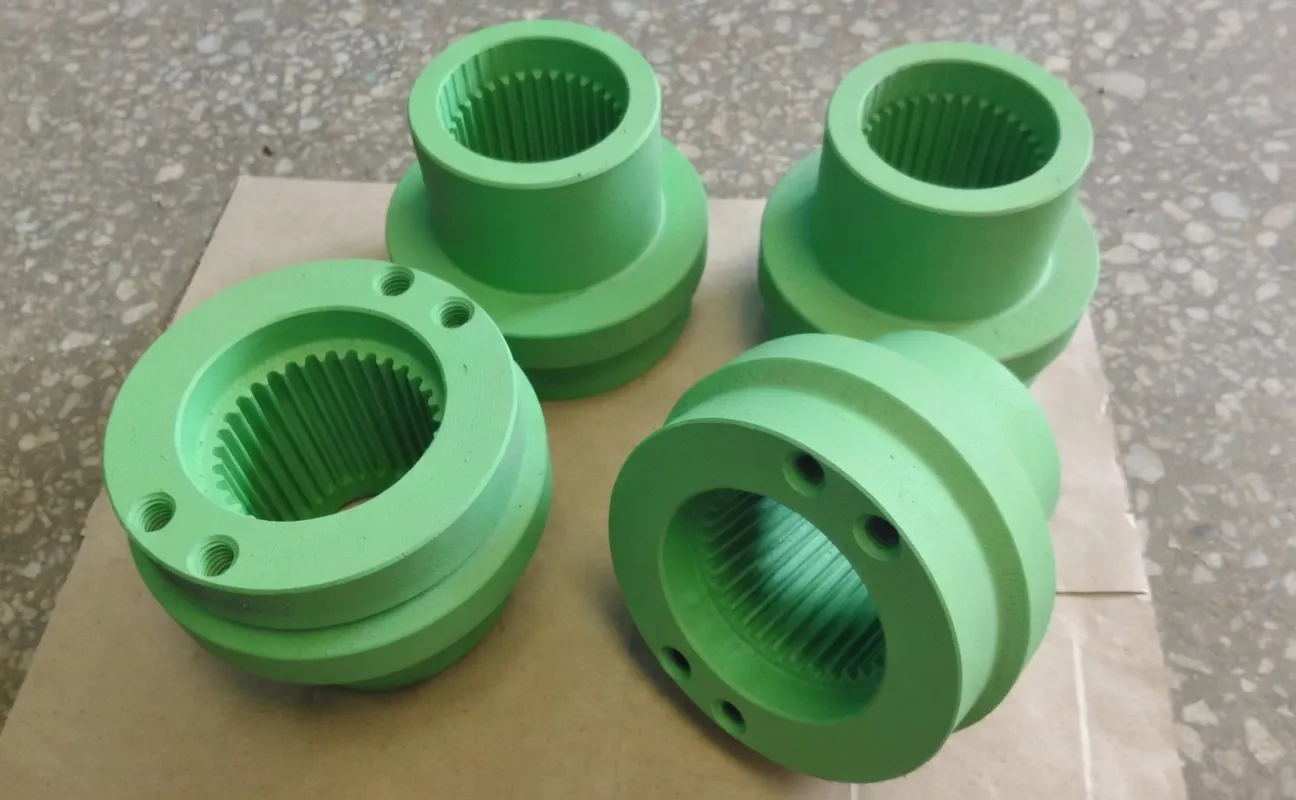
A gear type coupling consists of two hubs, each machined with external crowned gear teeth, and two outer sleeves (or a single barrel) with matching internal straight teeth. Torque is transmitted through the meshing of the hub’s external teeth against the sleeve’s internal teeth. The critical design feature that gives the gear coupling its misalignment-handling capability is the crown — the convex profile ground into the external hub teeth. This crown allows the teeth to rock slightly within the sleeve teeth as the shaft angle changes, transmitting full torque without imposing bending loads on the connected shafts.
For continuous casting machine service, Ever Power uses hub materials of 42CrMo4 or 20CrMnTi alloy steel, heat-treated to core toughness values of 900 to 1050 MPa tensile strength before carburising and case-hardening the gear teeth to 58-62 HRC surface hardness. This combination gives the tooth a hard, wear-resistant surface over a tough, shock-absorbing core — exactly the material architecture needed for a drive that sees both sustained high torque and occasional shock overloads. Sleeve materials are typically 45 steel or ductile iron for standard torque classes, and 42CrMo4 forging for the highest torque ratings used in large slab caster strand guide applications.
The sealing system used in CCM-grade couplings from Ever Power combines a labyrinth seal — which stops water from entering by virtue of the tortuous path it must negotiate — with a positively-retained lip seal that provides a secondary barrier against both water ingress and grease egress. This dual-seal approach is directly driven by the experience of seeing conventional single-seal designs fail in continuous casting environments where high-pressure water jets from spray cooling systems are directed at the coupling during normal operation.
Customer Success Case Study
Real-world performance from a UK integrated steel plant
Midlands Integrated Steelworks, United Kingdom
4-strand billet caster · Annual capacity 1.2 Mt · Operational since 1987, refurbished 2019
Испытание: Following a major caster refurbishment in 2019, the plant’s maintenance team identified gear couplings in the strand guide drive as the component with the highest failure frequency — averaging 3.4 coupling replacements per month across all four strands. Root-cause analysis attributed failures primarily to water ingress through worn single-lip seals and tooth fatigue from shock loads during strand speed changes. Downtime costs associated with unplanned coupling failures were running at approximately £28,000 per incident.
Решение: Ever Power supplied a custom batch of 96 CCM-grade gear type couplings sized to the original shaft interface dimensions but incorporating the dual labyrinth-plus-lip-seal system and premium 42CrMo4 carburised hubs. The units were delivered with a matched spare-parts kit and full dimensional inspection reports for each coupling. Installation was completed during a scheduled maintenance window with no additional outage required.
Results after 18 months: Unplanned coupling failures reduced by 94% — from 3.4 per month to an average of 0.2 per month. Mean time between coupling maintenance interventions extended from under 3 months to 14 months. Total annualised maintenance cost saving attributable to the coupling upgrade estimated at £380,000. The plant’s maintenance manager noted that the sealed-for-life feature was particularly valued, as it eliminated a lubrication task that had previously required confined-space entry on the lower strand guide segments.
“We have tried three different gear coupling suppliers over the years for our slab caster strand guide drives. Ever Power is the only one whose sealing system genuinely survives our high-pressure secondary cooling. The 14-month service interval has completely changed our maintenance planning.”
North East England integrated steel plant
“The custom bore and keyway dimensions were matched precisely to our existing roll shafts, so installation during our annual shutdown was completed without any machining on site. Technical support from the application engineering team was excellent throughout — they clearly understand CCM drives.”
Welsh integrated steelworks, South Wales
“As an OEM integrator for CCM equipment upgrades, we needed a gear coupling supplier that could deliver consistent quality, dimensionally verified documentation, and fast delivery on repeat orders. Ever Power has met every requirement on our last seven projects. Pricing is competitive and lead times are reliably short.”
Heavy industry OEM integrator, West Midlands
Производственные возможности Ever Power и услуги по индивидуальному проектированию.
No two continuous casting machines are identical. Equipment built across different decades, from different OEMs (Concast, Danieli, SMS, Voest-Alpine, Morgan), uses differing shaft diameters, bore configurations, keyway standards, and coupling envelope dimensions. Ever Power’s engineering team works directly with plant maintenance managers and procurement teams across the UK steel industry to design and manufacture gear type couplings that are dimensionally interchangeable with existing installations — without requiring modifications to the rolls, gearboxes, or motor shafts.
Our factory operates CNC hobbing and grinding centres capable of producing gear coupling hubs and sleeves from 50 mm to 900 mm pitch diameter, with DIN 3975/ISO 4156 spline options available alongside standard parallel and taper keyway configurations. Full material traceability is maintained from certified billet steel through heat treatment, machining, and final inspection — all documented in a coupling-specific data pack that supports your plant’s quality management system. For UK customers, shipping typically runs on a 6-to-10-week leadtime for custom items, with express options available for emergency maintenance situations.
Beyond dimensional customisation, Ever Power can engineer to a specific application torque, misalignment, and operating environment specification. This includes selecting gear module, number of teeth, crown radius, and seal configuration to match your exact CCM duty cycle rather than simply supplying the next standard size up. This application-specific approach consistently delivers longer service life compared with catalogue-standard couplings applied to CCM service without engineering review.
Customisation Capabilities at a Glance
| Bore diameter range | 30 – 500 mm |
| Keyway standards | DIN 6885, BS 4235, ANSI B17.1 |
| Flange bolt circle | Matched to OEM drawing |
| Gear module range | m2 – m16 |
| Material certs | EN 10204 3.1 available |
| Обработка поверхности | Phosphating, zinc spray, paint |
| MOQ for custom CCM | 4 pieces (lower on request) |
| Standard lead time | 6–10 weeks (express available) |
Serving the UK Steel and Heavy Industry Sector
The United Kingdom steel industry, centred on major sites in South Wales, the North East of England, Yorkshire, and the West Midlands, operates some of the most technically demanding continuous casting equipment in Europe. Plants handling long products — structural sections, rail, rod — as well as flat products — hot-rolled coil and plate — all rely on gear couplings throughout their CCM drivetrain. Ever Power supplies both direct to UK steel plant maintenance teams and through specialist steel plant engineering service companies operating from Sheffield, Rotherham, Newport, and other steel industry hubs.
Beyond primary steel production, the зубчатая муфта finds extensive application in UK electric arc furnace (EAF) mini-mill operations and in the downstream rolling mills that process CCM output into finished product. Enquiries from UK-based foundry and forge operations for heavy coupling supply and from OEM integrators managing plant upgrade projects in the British steel sector are handled by Ever Power’s dedicated export sales team, with pricing in GBP available on request.
Часто задаваемые вопросы
Voice-search friendly answers to the questions plant engineers and procurement teams are actually asking.
Ready to Specify or Source Gear Type Couplings for Your CCM Drive System?
Our application engineering team has supported continuous casting machine projects across the UK steel sector for nearly two decades. Share your shaft dimensions, torque data, or OEM part numbers and we will turn a detailed proposal around within 48 hours.
📧 Получить расчет стоимости — [email protected]
отредактировано gzl