 Inside every modern steel rolling mill, there is a moment of enormous mechanical stress that most engineers rarely discuss openly: the instant a steel slab bites into the rolls. In that fraction of a second, the drive system absorbs a shock load that can reach several times the rated torque. For UK steel producers competing on quality, uptime, and energy efficiency, the component sitting at the centre of that transfer — the gear type coupling — is quietly decisive. Get it right and you gain years of uninterrupted throughput. Choose poorly and the consequences cascade from bent shafts to unplanned shutdowns worth tens of thousands of pounds per hour in lost production.
This article draws on over eighteen years of applied engineering experience with gear type couplings across hot strip mills, cold rolling lines, and bar-and-rod mills. The aim is to give procurement engineers, plant reliability teams, and OEM designers in the UK a clear, technically grounded picture of why gear type couplings remain the dominant choice in rolling mill main drive systems — and exactly how to specify, maintain, and future-proof them.
Ever Power — Custom Gear Type Coupling Solutions for UK Rolling MillsGet a Quote — Contact Our UK Sales Team
Γιατί τα ελασματουργεία έχουν εξαιρετικές απαιτήσεις από τους συνδέσμους
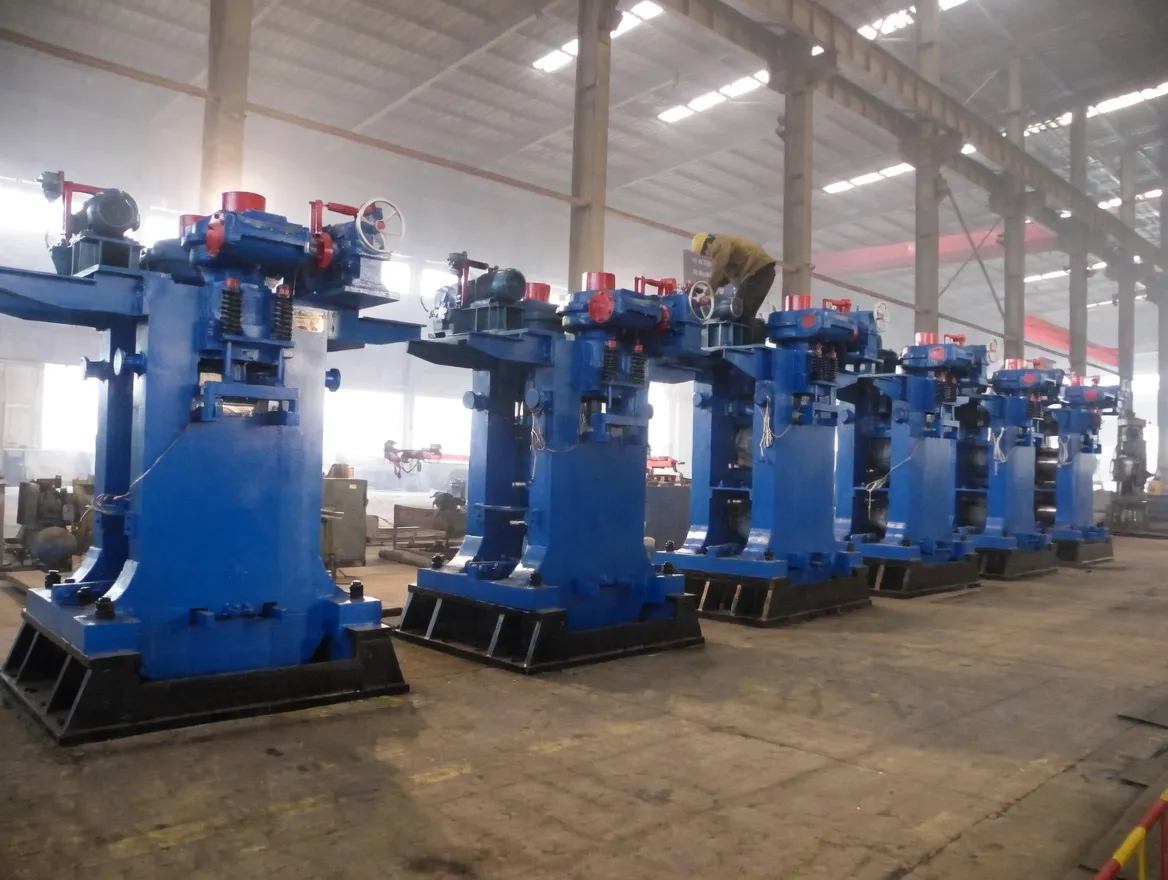
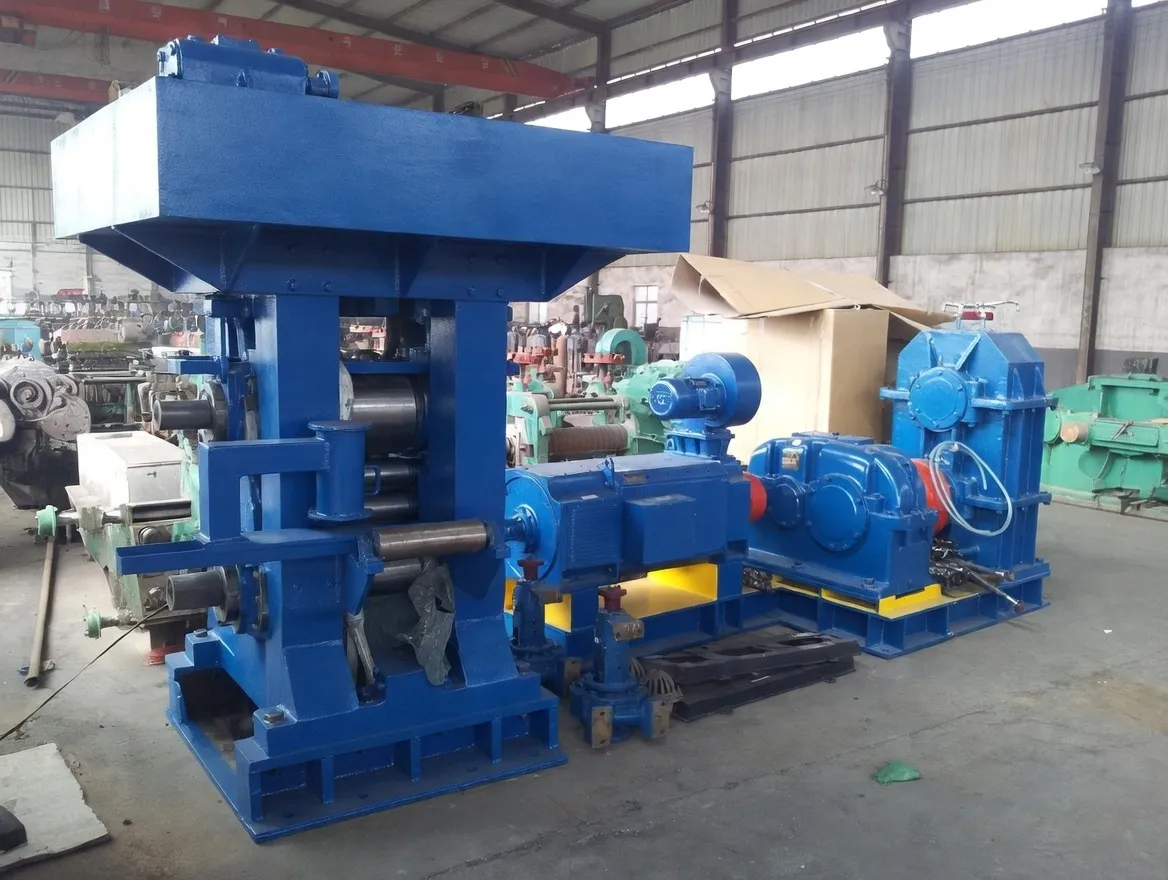 A rolling mill main drive system links a high-power motor — commonly ranging from 500 kW to over 10 MW in large flat-rolling applications — through a gearbox to one or more work rolls. The rolls exert compressive force on the steel, reducing its cross-section with each pass. What this description understates is the violence of the load cycle. At the moment of bite, when the leading edge of a hot slab contacts the rolls, the torque spikes sharply. In thick-slab hot rolling, peak torques can reach 2.5 to 4 times the steady-state figure. The coupling must transmit this surge without fracture, while simultaneously tolerating angular misalignment caused by roll-gap adjustments, axial float driven by thermal expansion, and parallel offset from worn bearings or shifted foundations.
No other coupling technology combines the required torque density, angular compensation, and shock-absorption capability as effectively as the gear type coupling. Its toothed sleeve-and-hub arrangement distributes load across multiple gear teeth simultaneously, and the crowned tooth profile is the key to unlocking angular flexibility without introducing harmful secondary bending moments into the shaft line. This is the engineering reason gear type couplings have been the industry standard in heavy rolling mills for over half a century, and why no credible alternative has fully displaced them in the highest-torque applications.
⚡ Peak Torque Absorption
Crowned gear teeth spread shock loads across the full tooth width, preventing point contact stress during slab bite events.
🔄 Angular Compensation
Accommodates up to 1.5° angular misalignment per gear mesh, essential for roll-gap adjustment without shaft-line distortion.
🔥 Thermal Resilience
Axial float accommodates thermal shaft growth, preventing dangerous thrust build-up at high operating temperatures in hot strip mills.
🔒 Sealed Lubrication
Labyrinth and lip-seal arrangements block mill-scale debris and cooling water from contaminating the gear mesh, extending service intervals.
Mechanical Principles: How a Gear Type Coupling Actually Works
At its core, a gear type coupling consists of two hubs — each machined with external crowned gear teeth — and one or two sleeves carrying internal straight or involute teeth. The hubs are keyed or interference-fitted to the drive and driven shafts. The sleeves bridge the gap and transmit torque through meshing contact. The genius of the design lies in the crown: each external tooth is ground to a barrel or spherical profile, narrowing slightly toward its tips. When angular or axial displacement occurs, the crowned teeth rock within the sleeve’s internal teeth rather than binding, and load redistributes automatically along the tooth face.
In rolling mill applications, two gear meshes are used in series — one at each end of a floating intermediate shaft — creating what the industry calls a double-engagement gear coupling. This arrangement allows the intermediate shaft to float freely in three-dimensional space, decoupling the motor and gearbox shaft centrelines entirely. The practical effect is that normal operational misalignment — which in a live rolling mill is continuous and variable, not a one-off installation error — is absorbed mechanically rather than passed into bearings, seals, and shaft fatigue zones. For an engineer tasked with maximising mean time between failures on a 24/7 production line, this is not a minor advantage. It is the difference between a coupling that lasts three years and one that lasts twelve.
Materials and Construction: What to Specify for Heavy Rolling
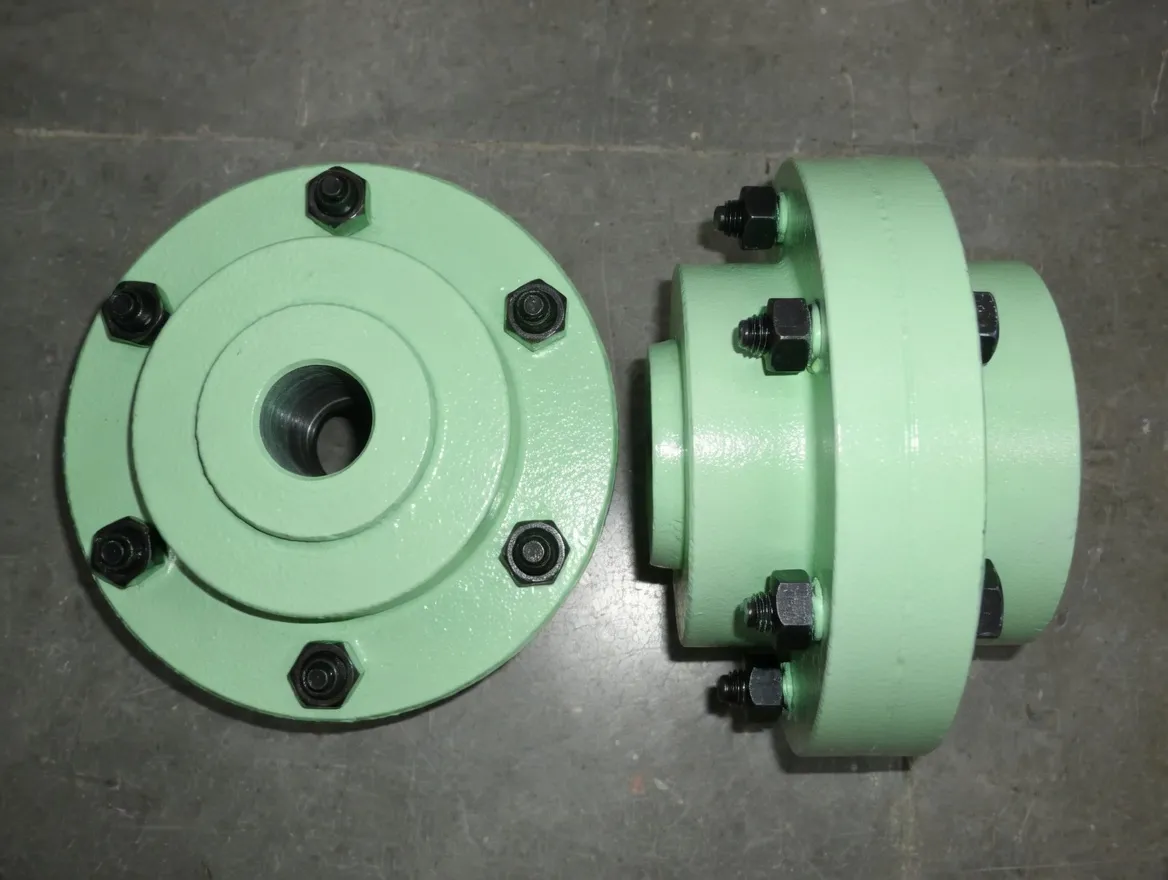 Material selection for a rolling mill gear type coupling is an exercise in competing priorities: toughness to survive shock loads, hardness to resist tooth wear, machinability to achieve the tight tolerances that crowned tooth profiles demand, and corrosion resistance to cope with water-spray and mill-scale environments. The majority of high-performance rolling mill couplings use case-hardened alloy steel for the hubs — typically 20CrMnTi or equivalent British Standard alloy steels — with case depths and core hardness values selected to match the tooth module and expected torque cycle. Sleeves are commonly made from medium-carbon alloy steel with through-hardening, giving the internal teeth enough surface hardness to resist fretting wear while retaining the bulk toughness needed to absorb shock without brittle fracture.
Lubrication philosophy matters at least as much as material selection. In hot-mill environments above 60°C ambient, EP (extreme pressure) grease with a NLGI Grade 1 or 2 consistency and a dropping point above 180°C is the standard choice. Cold-strip and temper mill applications operating at more moderate temperatures can use circulating oil lubrication, which allows continuous filtration and temperature monitoring. Regardless of lubricant type, the sealing system must prevent ingress of mill scale, cooling water, and emulsion — all of which are aggressively abrasive in a gear mesh context. A compromised seal on a rolling mill coupling does not merely shorten coupling life; it accelerates wear at a rate that can reduce a 24-month service interval to under six weeks.
Παράμετροι Τεχνικής Απόδοσης
The table below presents typical performance parameters for gear type couplings in rolling mill service. These figures are indicative of the WGZ and SWC series arc-tooth designs most commonly specified for UK steel plant applications. Final selection must always be validated against actual mill operating data.
| Παράμετρος | Light Rolling (Bar/Rod) | Medium Rolling (Section/Plate) | Heavy Rolling (Slab/Strip) |
|---|---|---|---|
| Ονομαστική ροπή (kNm) | 5 – 80 | 80 – 500 | 500 – 4,000+ |
| Peak Torque Multiple | 2.0 – 2.5× | 2.5 – 3.0× | 3.0 – 4.5× |
| Μέγιστη γωνιακή κακή ευθυγράμμιση | 1,5° | 1.0° – 1.5° | 0,5° – 1,0° |
| Αξονική πλεύση (mm) | ±5 – ±12 | ±10 – ±25 | ±20 – ±50 |
| Max. Operating Speed (rpm) | έως 3.000 | up to 1,500 | up to 600 |
| Recommended Safety Factor | 2.0 | 2.5 | 2.5 – 3.0 |
| Typical Hub Material | 42CrMo4 / 40Cr | 20CrMnTi / 18CrNiMo7 | 17CrNiMo6 / Bespoke Alloy |
| Lubrication Method | EP Grease | EP Grease / Flood Oil | Circulating Oil System |
Application Scenarios Across Rolling Mill Types
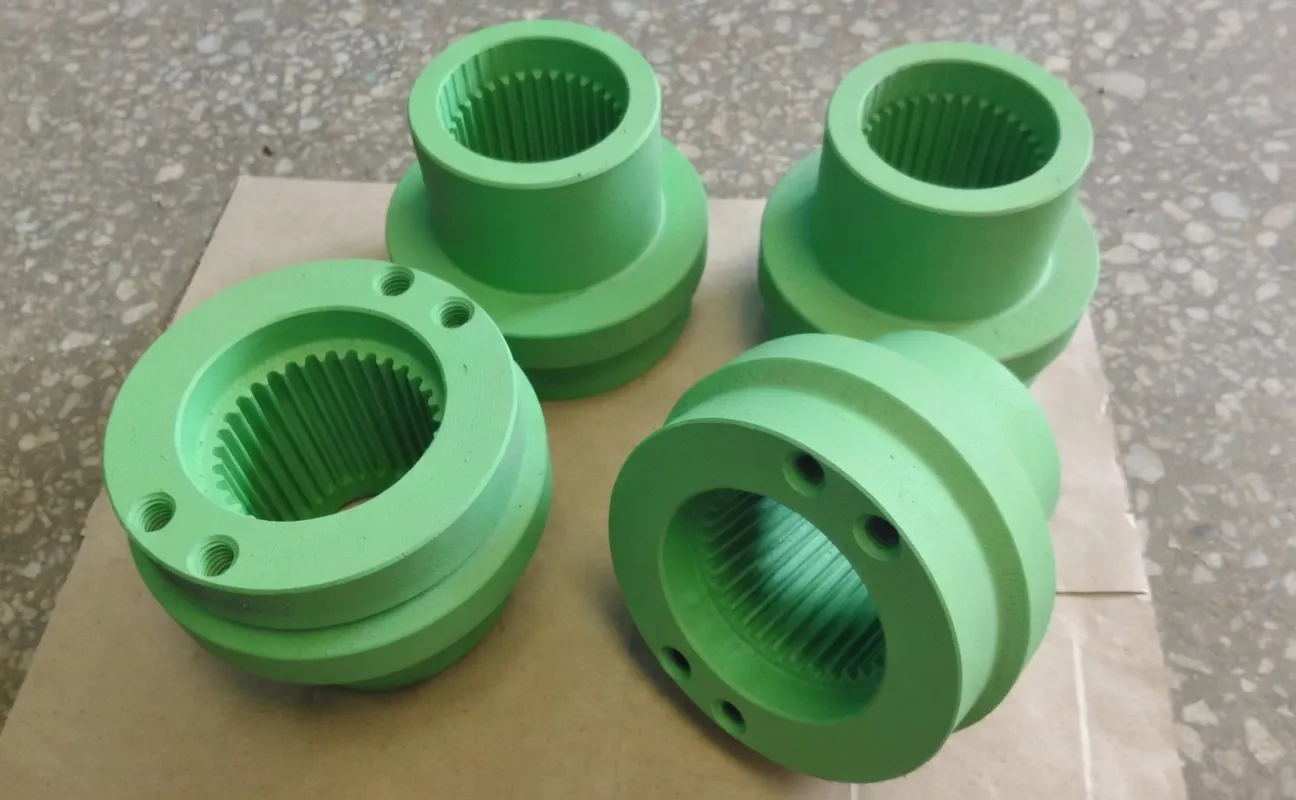 Gear type couplings are not a single product but a family of solutions tuned to very different rolling mill architectures. In a continuous hot strip mill, the coupling sits between the finishing stand motor and its gearbox, operating at moderate speed but under sustained high torque with frequent thermal cycling as the strip runs and the stand idles between coils. The key requirement here is reliable sealing and a generous axial float allowance — thermal expansion of the roll line can push shafts 30 mm or more over an operating shift. The SWC series arc-tooth gear coupling, with its large axial sliding range and robust labyrinth seal, is the standard solution on modern UK hot-strip lines.
Cold rolling presents a different challenge. Torque levels are lower than hot rolling for equivalent strip width, but speeds are significantly higher — some cold-mill main drives run above 1,500 rpm — and the drive spindles connecting the roll separating force backs to the roll necks must accommodate vertical roll adjustment in real time while transmitting torque. Here the gear type coupling’s angular flexibility is the defining feature, and tooth surface quality becomes critical because high-speed operation amplifies the dynamic effects of any tooth-form error. Precision-ground crowned teeth and balanced assemblies are non-negotiable in cold-mill spindle applications.
Bar and rod mills operate in a different regime again. Roll speeds are high, sometimes exceeding 100 m/s at the finishing blocks, but the torques per coupling are lower. What distinguishes bar and rod mills is the sensitivity to torsional vibration: the high-speed wire block can develop resonant vibration modes that concentrate fatigue damage at the coupling hub bore. In these applications, a slightly compliant or damped gear type coupling variant — or a carefully matched torsional stiffness — is sometimes chosen, and close collaboration between the coupling manufacturer’s application engineer and the mill’s drive system integrator is essential for a reliable outcome.
Hot Strip Mill
SWC arc-tooth type. Large axial float, high-temperature grease, robust labyrinth seals against scale and cooling water.
Cold Rolling / Temper Mill
Precision-ground crowned teeth, balanced assembly, circulating oil lubrication, close torsional stiffness matching.
Bar and Rod Mill
Torsional resonance analysis required. Higher-module teeth for wear life. Compact geometry to fit tight inter-stand spacing.
Heavy Plate Mill
Maximum safety factors. Reversing-duty fatigue analysis. Floating-shaft length matched to roll screwdown range. Bespoke alloy hubs.
Selection Guide: Calculating the Right Gear Type Coupling
Selection errors are the single largest source of premature coupling failures in UK rolling mills. The most common mistake is sizing purely on rated motor torque, ignoring peak torque multiples. For rolling mill duty, the design torque Td should be calculated as: Td = Tr × K, where Tr is the rated torque of the drive and K is a service factor accounting for the duty class. For hot-mill main drives with stall and bite loading, K typically lies between 2.5 and 3.0. The coupling’s rated torque must comfortably exceed this design torque, with an additional safety factor of no less than 1.25 applied on top of K to account for fatigue and operational uncertainty.
Beyond torque, a competent selection process checks bore diameter and hub strength to ensure the keyway and shrink-fit connection do not become the weak link. It verifies that the maximum operating angle at worst-case roll adjustment stays within the coupling’s angular capacity. It calculates the centrifugal loading at maximum speed to confirm the coupling will not over-stress its own fasteners or housing. And for floating-shaft designs, it checks the critical speed of the floating shaft to ensure the operating speed stays below 75% of the first lateral critical speed. All of this is documented engineering, not guesswork, and any reputable gear type coupling supplier should provide a formal selection calculation before order confirmation.
Customer Success: Tata Steel UK, Port Talbot Hot Strip Mill
The Challenge: A major UK integrated steelworks operating a continuous hot strip mill was experiencing coupling failures on the roughing mill main drive at intervals of 14 to 18 months. The coupling failures were characterised by accelerated tooth wear and fretting corrosion on the internal sleeve teeth, traced to a combination of inadequate sealing against cooling water ingress and undersized tooth geometry for the actual peak torque profile. Each failure required a planned maintenance shutdown of 38 hours, with direct production losses exceeding £180,000 per event.
The Solution: After a detailed drive-line audit including torsional analysis and measurement of actual operating torque profiles under biting conditions, the existing standard σύνδεσμος τύπου γραναζιού was replaced with a custom-engineered WGZ-series arc-tooth unit from Ever Power. The new design featured increased tooth module, a double-lip nitrile rubber seal backed by a labyrinth groove, and an upgraded EP grease specification with a dropping point of 210°C. Hub material was upgraded to 18CrNiMo7 case-hardened alloy.
The Outcome: The replacement couplings ran without intervention for 42 months before their first scheduled inspection, where tooth wear measurements showed less than 12% of allowable wear limit consumed. The mill has since standardised on this design across three additional drive positions, avoiding an estimated £540,000 in unplanned downtime costs over three years.
Customer Voices
“The application engineering support we received before and during commissioning was exceptional. The coupling has performed without a single intervention over 36 months of three-shift operation on our plate mill drive. That kind of reliability is genuinely hard to put a price on.”
— Maintenance Engineering Manager, Heavy Plate Mill, Sheffield, UK
“We had been struggling with a competitor product on our bar mill finishing train for two years. The Ever Power gear type coupling fitted directly into the same envelope, required no shaft modification, and we have had zero unplanned downtime related to the coupling since installation. The price was also more competitive than we expected for the level of customisation involved.”
— Plant Reliability Engineer, Long Products Mill, Scunthorpe, UK
“When we came to Ever Power with an unusual bore-to-face dimension caused by our gearbox arrangement, they produced a modified floating-shaft coupling within six weeks, complete with full material certificates and dimensional reports. For a bespoke part of this complexity, that turnaround was very impressive.”
— OEM Drive Systems Engineer, Industrial Equipment Manufacturer, Birmingham, UK
Ever Power: Custom Gear Type Coupling Manufacturing for UK Industry
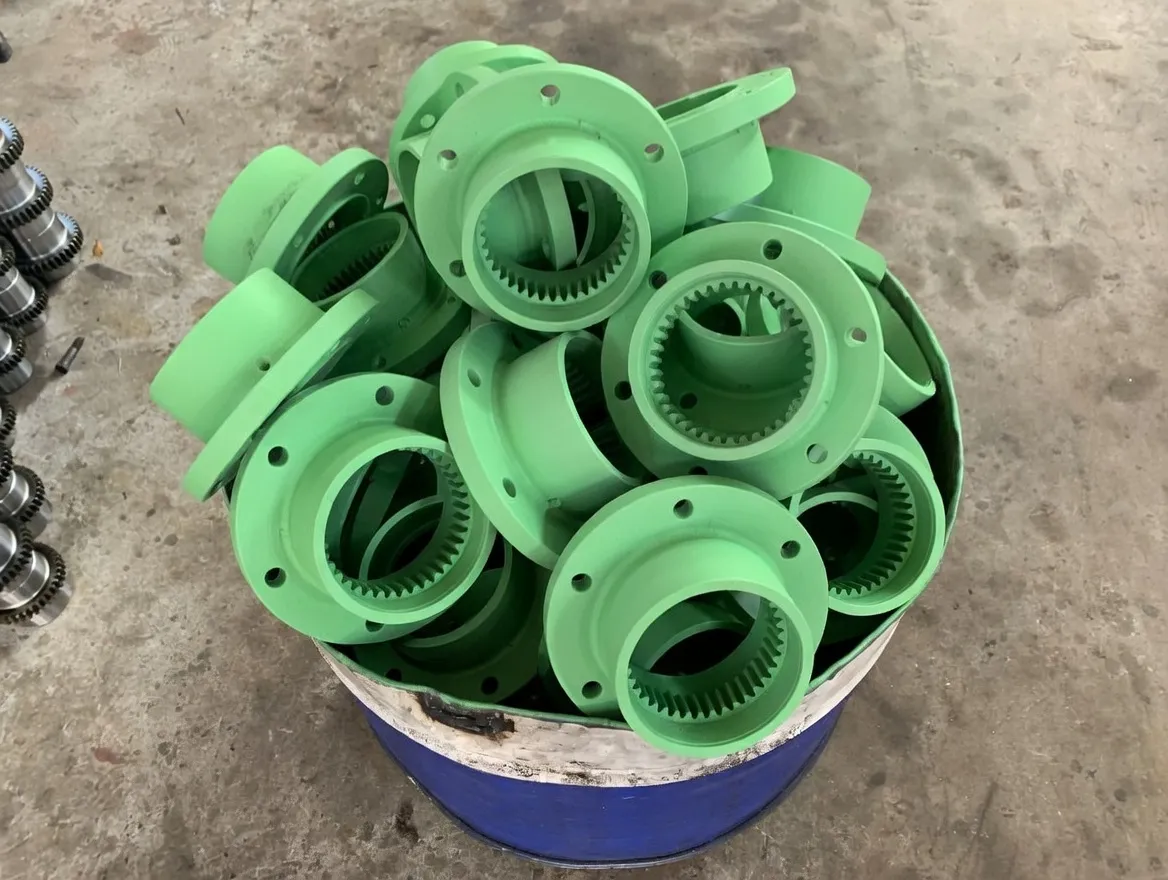 Standard catalogue couplings serve straightforward applications well. Rolling mills, by their nature, are rarely straightforward. Bore dimensions dictated by legacy shafts, non-standard keyway specifications, constrained envelope dimensions, unusual material requirements for corrosion or temperature resistance, bespoke intermediate shaft lengths — these are the day-to-day realities of rolling mill coupling procurement. Ever Power’s manufacturing capability addresses all of these variables. Our CNC gear-grinding facility produces crowned tooth profiles to DIN 3960 tolerances across the full range of modules from 2 to 40, and our in-house metallurgy team specifies and verifies heat treatment for every production batch.
The customisation process begins at the enquiry stage. When a UK customer sends us their drive data — motor torque curve, gearbox output shaft dimensions, roll-gap adjustment range, operating speed, and environmental conditions — our application engineers produce a formal selection calculation within 48 hours. This is not a catalogue lookup. It is a documented engineering analysis that considers dynamic loading, fatigue life, thermal behaviour, and lubrication strategy. For replacement couplings on existing mills, we offer a dimensional survey service, and for new mill designs, we work directly with OEM gearbox suppliers to optimise the shaft-line interface. Every bespoke coupling ships with a material certificate, dimensional report, and a torque-test certificate traceable to calibrated instrumentation.
Ready to specify a gear type coupling for your rolling mill? Our UK-dedicated application engineers are available for technical consultations Monday to Friday.
Maintenance Strategy: Getting the Most from Your Coupling Investment
Even the most precisely engineered gear type coupling will underperform if the maintenance strategy around it is poorly designed. The most valuable investment a rolling mill maintenance team can make is in condition monitoring. Vibration analysis at the coupling frequency — calculated from tooth count and shaft speed — gives early warning of tooth wear or lubrication breakdown months before a failure would occur. Thermographic inspection of the coupling housing during operation can detect abnormal friction arising from seal damage or lubricant starvation. These are not expensive techniques, but they require consistent data collection and a baseline vibration signature taken when the coupling is new and correctly aligned.
Planned grease replenishment intervals should be based on operating hours and temperature, not fixed calendar dates. A coupling running at high temperature in a hot-strip environment will consume and oxidise its lubricant significantly faster than one on a cold temper mill. As a working guideline, re-greasing every 2,000 to 3,000 operating hours is a reasonable starting point for hot-mill applications, adjusted based on grease condition monitoring. When a coupling is opened for inspection, tooth surfaces should be examined under magnification for pitting, spalling, fretting marks, or polishing patterns that indicate the crown profile is being overloaded at specific contact zones — evidence that the alignment or load duty has changed since the original specification. This information should feed back into the selection database to improve future designs.
Συχνές ερωτήσεις
επεξεργασία από gzl