 In any oil drilling operation, the rotary table is the mechanical heart of the wellbore process. Raw rotational power generated by diesel engine packages or high-torque electric drives is channelled through a multi-stage gearbox and ultimately converted into the sustained, controlled spin that turns a drill string thousands of metres into the earth. Sitting at the junction of these stages — bearing the full mechanical load every second the drill bit is rotating — is the gear type coupling. Compact on the schematic, yet irreplaceable in practice, it is the component that separates smooth, continuous drilling from costly, unplanned downtime.
What makes the rotary table environment particularly demanding is its fundamental unpredictability. Drilling torque does not arrive in smooth, modelled waves. It surges when the bit bites into hard limestone or quartzite, reverses violently when a stuck drill string suddenly releases, and oscillates continuously as formation types shift every metre downhole. Standard elastomeric or jaw-type flexible couplings cannot reliably absorb these combined shock loads at oilfield torque magnitudes. Only a correctly specified gear type coupling — with its involute-tooth engagement, crowned-tooth geometry, sealed lubrication system, and engineered misalignment tolerance — can handle the full dynamic range of torque while keeping the drivetrain aligned and protected. For UK oil and gas operators working across the North Sea Continental Shelf and onshore, this reliability is not just desirable — it is a direct operational and financial requirement.
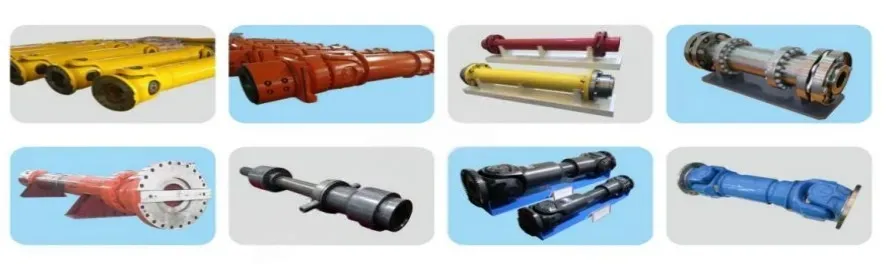 Ever Power gear type coupling in rotary table drive configuration — engineered for sustained high-torque oilfield service
Specifying a gear coupling for a rotary table, top drive, or mud pump drive system?
4-hour response · Custom sizes & flanges · Full oilfield documentation · UK delivery
How Gear Type Couplings Function in a Rotary Table Drive System
Mechanism · Load Path · Why the Tooth Geometry Matters
 A gear type coupling transmits torque through two sets of externally cut involute teeth — one machined onto each shaft hub — meshed continuously inside a common outer sleeve that carries a matching set of internal teeth. Unlike a rigid flanged coupling that bolts shafts together and demands near-perfect alignment, the gear coupling’s tooth profile is deliberately shaped with a barrelled, crowned curve along its working length. This crowning is the engineering foundation of the entire design. As the two hubs flex slightly relative to each other — due to shaft misalignment, rig structural movement, or thermal expansion — the crowned tooth profile rocks within the sleeve tooth without generating destructive bending loads at the shaft shoulder. Angular misalignment up to approximately 1.5 degrees, axial displacement of several millimetres, and minor parallel offset can all be accommodated simultaneously, without any increase in transmitted torque or thermal generation at the mesh.
In the rotary table drive chain, the gear coupling is positioned between the output shaft of the SCR-fed electric motor (or the mechanical gearbox output on diesel-driven rigs) and the rotary table input shaft. During initial acceleration, the coupling transmits starting torque smoothly across the full tooth width. When the bit encounters an unexpectedly hard layer and torque spikes sharply — a condition drilling engineers know as stick-slip — the crowned teeth distribute the peak load rather than concentrating it at a single point along the tooth face, preventing tooth fracture and protecting the motor bearings from axial thrust events. When the rig cycles between drilling and connection operations, the coupling’s axial freedom prevents shaft thermal expansion from loading the motor bearing end-play to destruction.
Lubrication is inseparable from gear coupling performance in oilfield service. The enclosed sleeve retains a charge of high-viscosity gear grease, coating the meshing teeth and preventing metal-to-metal fretting under the oscillating, reversing torque that characterises rotary drilling. On North Sea platforms, where deck ambient temperatures range from near-freezing in January to +40°C during summer operations, grease specification becomes a distinct engineering decision. The grease must remain fluid enough at low temperature to distribute across the teeth at start-up, yet resist centrifugal expulsion at drilling speed and thermal thinning at elevated running temperatures. Ever Power supplies all oilfield-grade gear couplings with a matched grease pack, selected for the specific operating temperature range of each order.
Technical Specifications: Gear Type Coupling for Oil Drilling Applications
Standard Industrial vs Heavy-Duty Oilfield Performance Parameters
| Parameter | Standard Industrial | Heavy-Duty Oilfield Grade |
|---|---|---|
| Nominaal koppel | 500 – 80,000 N·m | 10,000 – 250,000 N·m |
| Peak / Shock Torque | 2.0x nominal | Up to 5.0x nominal |
| Maximale bedrijfssnelheid | 100 – 3,600 rpm | 60 – 800 rpm (oilfield range) |
| Hoekafwijking | ±0.5° – ±1.0° | Up to ±1.5° |
| Axiale verplaatsing | ±1 – ±5 mm | ±3 – ±15 mm |
| Bedrijfstemperatuur | -20°C to +80°C | -40°C to +120°C |
| Hub Bore Range | 20 – 200 mm | 80 – 500 mm |
| Naafmateriaal | Cast Iron or Medium Carbon Steel | 42CrMo4 / 34CrNiMo6 Alloy Steel |
| Tooth Surface Hardness | HRC 45 – 50 | HRC 55 – 62 (carburised & quenched) |
| Seal Specification | Standard NBR O-ring | Double-lip FKM / IP66 API-grade |
| Surface Protection | Paint / Zinc phosphate | Electroless nickel / Hot-dip galvanised |
All values indicative. Exact specifications are confirmed at drawing-approval stage. Contact [email protected] for your application data sheet.
Five Reasons Drilling Engineers Specify Gear Type Couplings
Performance Advantages Validated Across UK and Global Oilfield Operations
Extreme Torque Capacity with Inherent Overload Tolerance
Gear type couplings transmit torque through involute tooth engagement distributed across a substantial contact area, spreading loads that would fracture the element of any elastomeric design. In rotary table drives, peak torques during severe stick-slip events can reach three to five times nominal drilling torque within fractions of a second. A correctly specified gear coupling handles this without permanent deformation — the crowned tooth profile allows controlled micro-slip before transmitting destructive loads to the gearbox or motor bearings. For land-based UK rigs operating into Carboniferous limestone or mudstone sequences common in Yorkshire and the East Midlands, this overload resilience translates directly into extended gearbox service life and significantly reduced bearing replacement costs across a drilling programme.
Three-Dimensional Misalignment Compensation
No rig floor is perfectly level, and no shaft installed under field conditions is perfectly concentric with its counterpart. The gear type coupling accommodates simultaneous angular, axial, and parallel offset misalignment — a three-dimensional combination that rigid couplings and disc couplings simply cannot manage at oilfield torque levels without generating catastrophic bending moments at the shaft. This tolerance is particularly valuable on North Sea semi-submersibles and jack-up rigs, where wave action and wind loading cause the deck structure to flex continuously, constantly shifting the relative positions of drive components. The gear coupling absorbs this dynamic misalignment cycle, preventing the chronic bearing wear and shaft fatigue cracking that afflict rigidly connected drivetrains within a single hitch.
Sealed Construction Resistant to Drilling Mud and Seawater
The environment surrounding a rotary table is aggressively hostile to all mechanical components. Water-based and oil-based drilling fluids spray in every direction during connections, entrained solids act as abrasive particles on any exposed surface, and seawater spray on offshore decks accelerates corrosion of unprotected steel. Gear type couplings in oilfield configuration are sealed with multi-lip seals and treated with anti-corrosion coatings that block both fluid ingress and external atmospheric corrosion. The sealed sleeve cavity retains its grease charge under the centrifugal force of full drilling speed, preventing lubricant starvation while the external seals keep mud away from the tooth mesh. In practice, this architecture extends service intervals to match full campaign lengths of 90 to 180 days without any intervention.
Arctic-to-Desert Operating Range for Global Deployment
British oil and gas operators work across an extraordinary geographic range — sub-Arctic Norwegian and Barents Sea conditions in winter, equatorial West African heat in summer, and the North Sea’s relentless cold salt-spray environment year-round. A gear type coupling designed for these deployments must function without brittle fracture at -40°C and without seal failure at sustained +120°C running temperatures. Heavy-duty oilfield gear couplings are manufactured from low-alloy chrome-molybdenum steel (42CrMo4, the international equivalent of AISI 4140) that retains ductility and toughness at cryogenic temperatures. FKM (Viton) or PTFE seals are fitted as standard on all export orders from UK-based procurement offices, covering the full global deployment range in a single specification.
Field-Replaceable Without Drive Disassembly
On a producing drilling rig, every hour of unplanned downtime costs tens of thousands of pounds. Gear type couplings are designed with split-sleeve or flanged-hub configurations that allow the worn sleeve to be removed and replaced without pulling the motor or gearbox from their seating arrangements. A competent rig mechanic can access the coupling, inspect the teeth for wear patterns, regrease, and reinstall within two hours — often during a scheduled connection or pipe trip. Combined with Ever Power’s same-day dispatch capability from our UK distribution point and DDP delivery to Aberdeen or Great Yarmouth, this field-replaceable architecture keeps scheduled maintenance exactly that — scheduled, planned, and within the rig’s operational rhythm rather than dictated by an emergency failure event.
Material Engineering: Inside an Oilfield-Grade Gear Coupling
Forged Steel Construction · Carburised Tooth Profiles · Oilfield Sealing Systems
The performance gap between a general industrial gear coupling and one specified for oil drilling rotary table service comes down almost entirely to material selection and heat treatment discipline. At Ever Power, oilfield-grade gear couplings begin life as forged alloy steel blanks rather than castings. Forging aligns the steel’s grain structure along the load path, eliminating the porosity and micro-inclusions that machined castings inevitably retain and that act as fatigue crack initiation sites under cyclic torque loading. Hub forgings are produced from 42CrMo4 (directly equivalent to AISI 4140) or 34CrNiMo6 for the most demanding applications, both selected for their combination of high tensile strength (900–1,100 MPa after heat treatment), excellent impact toughness at sub-zero temperatures, and proven resistance to fatigue crack propagation under fluctuating bending and torsional loads.
Tooth geometry is precision-machined to DIN 3990 or AGMA standards using CNC gear hobbing centres with in-process measurement. The loaded tooth flanks are then carburised to a case depth of 0.8–1.4 mm and quenched to achieve a surface hardness of HRC 55–62 while the core remains at HRC 28–36 — tough and ductile. This case-hardening approach is fundamental to the coupling’s longevity: a fully through-hardened tooth would be brittle and prone to sudden fracture under shock loading; a surface-hardened tooth resists the wear and pitting at the contact face while the tough core absorbs impact energy without crack propagation. After heat treatment, the crowned tooth profile is precision-ground to eliminate any distortion from the quench process and ensure load is uniformly distributed across the tooth width during the small angular deflections of normal oilfield service.
The outer sleeve is manufactured from EN36A or equivalent case-hardening steel, providing a tough substrate for the internal tooth form. Sealing systems on oilfield couplings use double-lip NBR seals as a minimum, with FKM (Viton) seals supplied as standard for all temperature-critical or chemically aggressive environments — which covers virtually every offshore application. All external surfaces receive either electroless nickel plating (for precision tolerance requirements) or hot-dip galvanisation (for maximum corrosion protection on exposed deck-mounted installations) before packing and dispatch to UK customers. Material certificates to EN 10204 3.1 and full dimensional inspection reports accompany every oilfield order as a standard deliverable, meeting the traceability requirements of UK Continental Shelf operators without additional surcharge.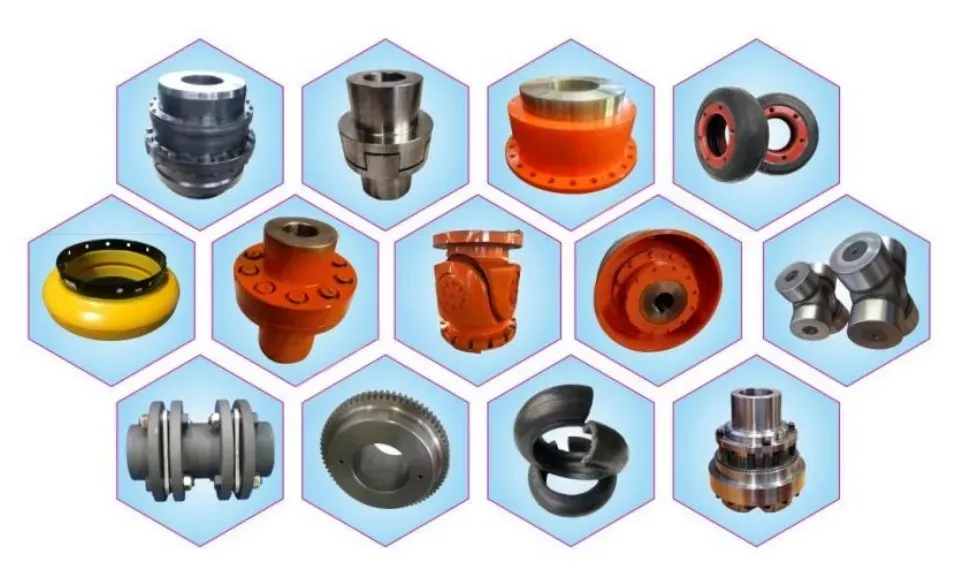
Application Scenarios Across UK and Global Oil & Gas Operations
Rotary Table · Top Drive · Mud Pump · Drawworks
▶ Rotary Table Drive — The Primary Application
The rotary table converts the comparatively high-speed, lower-torque output of the motor-gearbox unit into the very low speed and very high torque needed to rotate a full-weight drill string under bit weight. The gear coupling at this junction handles peak torques exceeding 150,000 N·m on deepwater well programmes, while simultaneously accommodating the structural flex of the substructure that supporting a 500-tonne travelling block inevitably induces. North Sea operators drilling into the Rotliegend Sandstone in the Southern Bight or the Chalk Group on Central North Sea high-pressure/high-temperature wells have reported that gear-coupled drives run continuously through full 28-day hitch rotations without any coupling-related call-out, even when operating in sea states that produce platform roll exceeding 3 degrees.
▶ Top Drive Swivel Drive Spindle Connection
Modern top drive systems on UK North Sea rigs use gear type couplings to connect the AC or DC traction motor output to the main shaft carrying the swivel and drill pipe. This coupling must operate in a hanging, continuously rotating environment where centrifugal force acts on the grease charge and side loads are imposed by conductor pipe deflection during surface casing landing sequences. Custom-flanged gear couplings with dynamically balanced sleeve assemblies are specified for top drive service, manufactured to API 8C or drawing-controlled standards with full material traceability documentation — a non-negotiable requirement for all safety-critical drive components on UKCS-operated rigs under the Offshore Installations (Safety Case) Regulations.
▶ Triplex Mud Pump Crankshaft Drive
Triplex mud pumps circulate drilling fluid at pressures up to 500 bar throughout the drilling process. Their crankshafts are driven by gear-coupled motor-gearbox sets that must start under full-pressure mud load — generating extremely high instantaneous torque demand that can destroy poorly specified couplings in a single start cycle. Gear type couplings are designed precisely for this application: they absorb starting shock loads and accommodate the differential thermal expansion between the pump casing (which runs at elevated fluid temperature) and the cooler gearbox housing. UK onshore drilling operations in the East Midlands, Lincolnshire, and exploratory Bowland Shale wells in Lancashire have specified oilfield-grade gear couplings for this exact service requirement.
▶ Drawworks Main Drum Drive
The drawworks is the rig’s primary hoisting system, raising and lowering drill strings, casing strings, and completion equipment — it is one of the hardest-worked mechanical systems on any rig. Drive motors are coupled to the drum through multi-stage gearboxes with gear type couplings at each stage transition. The intermittent, high-inertia braking loads generated when setting down heavy drill collar assemblies create reverse torque spikes that must transmit back through the coupling train without backlash-induced impact damage. Gear type couplings handle bidirectional torque demand without the compliance and heat generation that rubber-element couplings would exhibit under the same loading cycle, making them the established choice for drawworks drive train specification on UK rigs.
Customer Success Case: North Sea Contractor Eliminates Rotary Drive Downtime
UK Continental Shelf · Offshore Drilling · Verified Engineering Outcome
UK NORTH SEA / UKCS
SEMI-SUBMERSIBLE RIG
De uitdaging
North Caledonian Drilling Ltd, a mid-tier offshore drilling contractor operating a semi-submersible rig on a Central North Sea deepwater campaign, was experiencing repeated gear coupling failures on their rotary table drive at 45–60 day intervals — well below their 120-day campaign target. The failures presented as accelerated tooth flank wear with grease leakage past degraded end seals. Root cause analysis identified two compounding factors: the incumbent coupling used a straight-cut (non-crowned) tooth profile that generated theoretical point contact under the angular deflection induced by deck flexing, and the seal compound was not matched to the elevated ambient temperature from adjacent diesel exhaust routing, causing premature seal hardening and grease loss within the first few weeks of each campaign.
De oplossing
Ever Power’s UK technical sales team conducted a review at the Aberdeen shore base, examining the worn components and the drive arrangement drawings. The team proposed a direct replacement gear coupling retaining the existing bore and flange interface dimensions (for drop-in installation without modification) but upgrading to a fully crowned tooth profile manufactured from 42CrMo4 at HRC 58–60 surface hardness, with FKM high-temperature seals rated to +150°C. Two full campaign sets — four koppelingen in total — were manufactured to a custom production drawing, subjected to factory acceptance testing, and delivered DDP to the Aberdeen logistics hub within 26 working days of purchase order acceptance.
The Result
(vs 45–60 day baseline)
stoppages over campaign
cost avoided
Aberdeen delivery
What UK Drilling Engineers and Buyers Say
Verified Feedback From Oilfield Operations & Procurement Teams
“We fitted Ever Power units on two rotary table drives during a rig yard period in Aberdeen. The change was straightforward — the bore and flange dimensions matched exactly — and the difference in service life was immediate. We completed a 90-day Central North Sea campaign without a single coupling inspection call-out. That had genuinely never happened with our previous supplier’s product. The technical conversation before purchase was refreshingly specific, not a generic sales script.”
“In oilfield procurement you need availability, documentation, and competitive pricing — in that order. Ever Power delivered our custom-flanged gear couplings to our Aberdeen logistics warehouse in 26 days from drawing approval, with full 3.1 material certificates, dimensional inspection records, and heat treatment charts included without any additional charge. For a UKCS-regulated asset that is exactly what we require. The units have been running on two mud pump crankshaft drives for over eight months with no issues whatsoever.”
“We operate rigs in West Africa and the Middle East, procuring through our London engineering office. The gear type couplings needed for an Angola deepwater programme required a non-standard flange pattern with a specific bore keyway configuration. Ever Power turned around the drawing approval in under 48 hours and had components ready for third-party inspection within five weeks. The quality of the tooth grinding and the crowning geometry were precisely as specified. This is a company that actually understands gear coupling engineering — not just a catalogue distributor reprinting a competitor’s datasheet.”
Veelgestelde vragen
Questions From UK Drilling Engineers & Procurement Teams
Choosing the Right Gear Type Coupling for Your Drilling Operation
The gear type coupling is not the most visible component on a drilling rig, but the consequences of getting the specification wrong — or accepting a substandard part from an unfamiliar supplier — are entirely visible in the maintenance log and the downtime cost report. Every aspect of the design, from the crowned tooth profile and alloy steel forging to the high-temperature seal compound and corrosion protection system, exists to ensure that your rotary table drive runs continuously through drilling campaigns that demand maximum utilisation from every mechanical component.
For UK oil and gas operators — whether you are running jack-ups in the Central North Sea out of Aberdeen, managing a land rig programme in Lincolnshire, or procuring globally through a London engineering office — Ever Power provides the engineering knowledge, manufacturing precision, logistics capability, and documentation discipline to deliver gear type couplings that perform exactly as specified, every campaign. The combination of 18 years of application engineering experience, in-house manufacturing from forging to final inspection, and a genuine commitment to the technical requirements of the UK oilfield sector makes Ever Power the coupling partner that the industry’s most demanding operators trust.
bewerkt door gzl