By Ever Power Engineering Team | Published for UK Steel & Metals Industry
In the heart of every steel mill across the United Kingdom — from the strip mills of South Wales to the rod and bar lines of the North East — one mechanical component quietly bears the full weight of production: the gear type coupling. Without it, the colossal torque generated by multi-megawatt drive motors could never reliably reach the rolling rolls that shape raw steel billets into finished product. This article draws on over 18 years of field experience in coupling applications to explain exactly why gear type couplings dominate rolling mill main drive systems, how they are engineered for the harshest possible duty, and what UK plant engineers and procurement managers need to consider when specifying or replacing them.
Ever Power gear type coupling — engineered for rolling mill main drive duty
Why the Main Drive Is the Most Demanding Coupling Application in Metallurgy
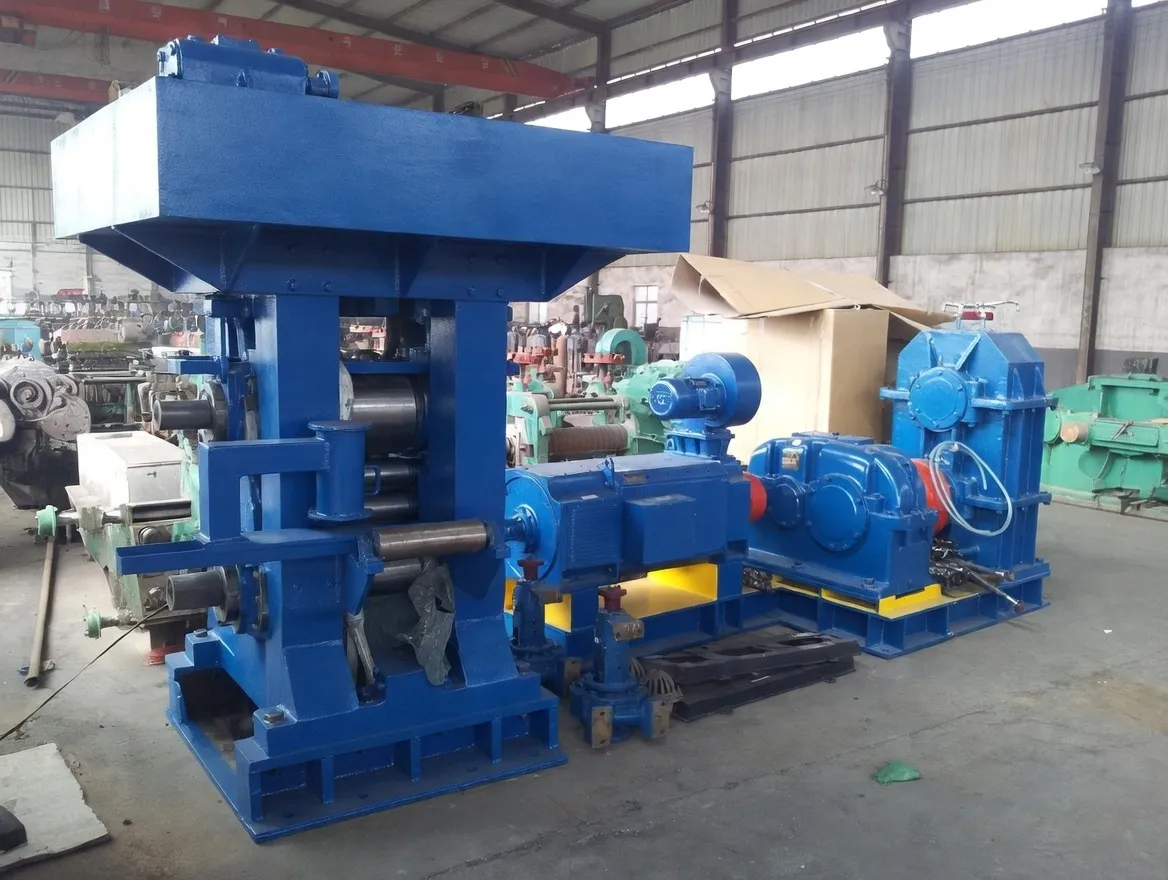
 The rolling mill main drive is a system that converts electrical energy — often in excess of 5,000 kW per stand — into the mechanical force needed to reduce steel cross-sections at high speed. The drivetrain typically runs from a synchronous or wound-rotor induction motor, through a multi-stage gearbox, and finally to the roll neck. Every junction in that chain is a potential failure point, and the coupling that bridges motor to gearbox, and gearbox to roll, faces conditions that most industrial couplings would never survive for long. Peak torque during biting — the instant the work piece enters the roll gap — can exceed six times the rated torque in a fraction of a second. Reversing hot strip mills impose additional cyclic loads as the slab is passed back and forth. Angular misalignment introduced by roll gap adjustment, thermal expansion of the mill housing, and wear of roll neck bearings can accumulate to 1.0°–1.5° in service. Axial float from roll neck thrust loads adds yet another demand. It is this precise combination of extreme torque capacity, misalignment compensation, and shock absorption that makes the gear type coupling the preferred choice of drive engineers worldwide and, specifically, across British steel operations.
How a Gear Type Coupling Actually Works in a Rolling Mill Context
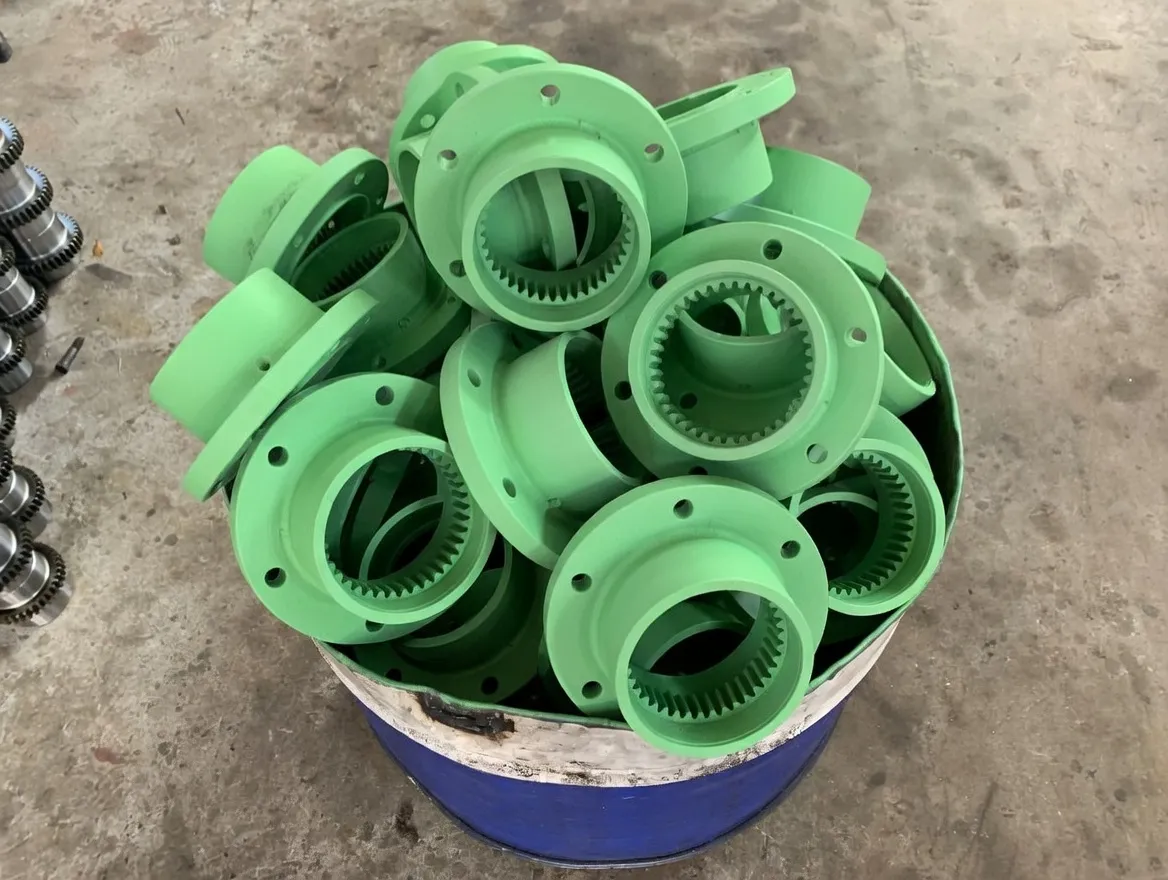
A gear type coupling transmits torque through the meshing of crowned external teeth on a hub sleeve with internal teeth on an outer sleeve (also called a drum or barrel). The involute tooth profile ensures full-area load distribution across the tooth flank, not just at the tip or root. What distinguishes the gear type coupling from other rigid or flex couplings is the crown geometry machined onto the external teeth: a carefully calculated spherical curvature that allows the hub to rock inside the drum by up to 1.5° without binding, while maintaining continuous tooth contact and therefore continuous torque transmission.
In a rolling mill configuration, two gear coupling halves are typically connected by a floating intermediate shaft — a spindle or spacer tube — that absorbs the offset between gearbox output and roll neck without transmitting bending moments into either shaft. The intermediate shaft can range from a few hundred millimetres to over three metres in length depending on the mill stand geometry. Lubricant — either grease or circulating oil — is retained inside the drum by precision-machined labyrinth seals and O-ring elements, forming the only barrier between the tooth mesh and the aggressive environment of mill scale, steam, and water jet cooling that defines the hot rolling floor. The design must also accommodate axial displacement: as rolls wear and are re-ground, the roll body moves axially within the housing, and the coupling must allow this float without generating destructive thrust on the gearbox bearings. Typical axial capacity is ±5 mm to ±15 mm, engineered into the tooth width and the spigot fit of the coupling halves.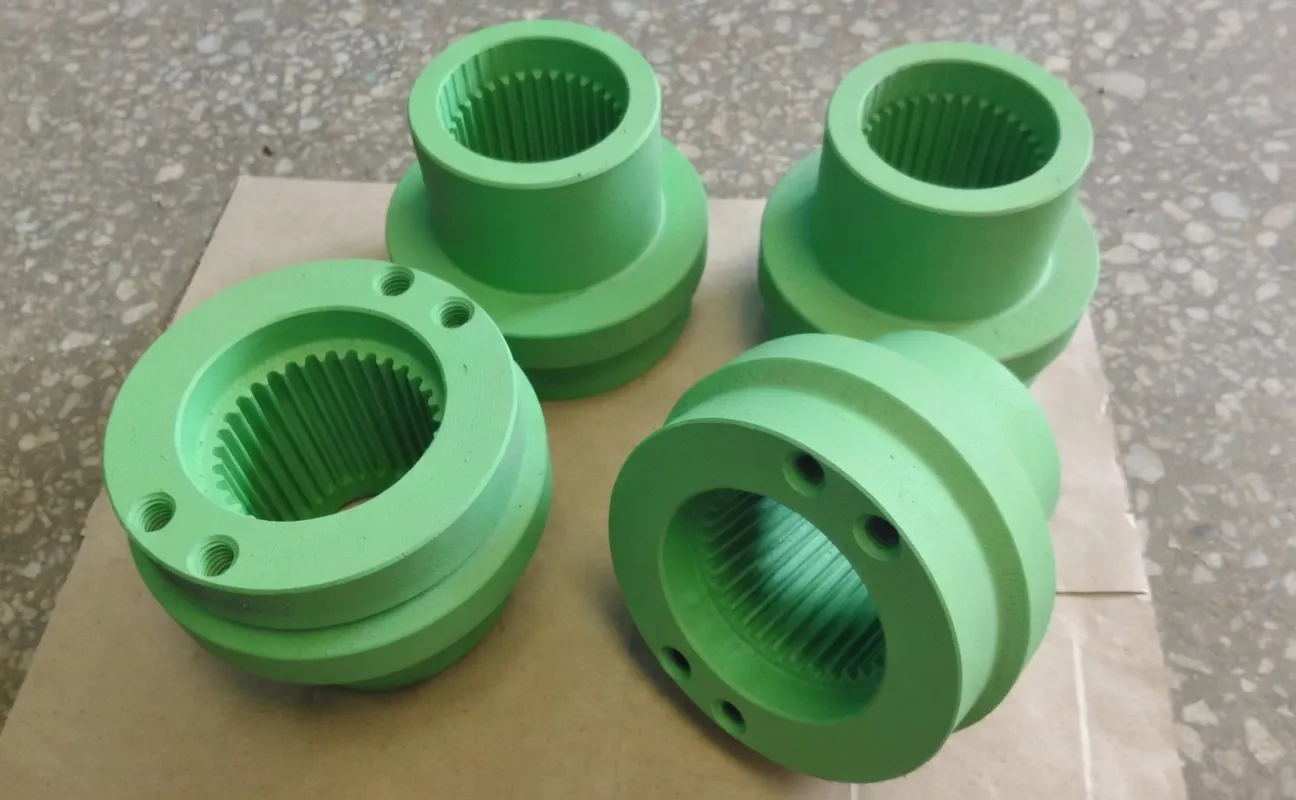
Technical Performance Parameters — Ever Power Rolling Mill Gear Type Couplings
| พารามิเตอร์ | Value / Range | หมายเหตุ |
|---|---|---|
| แรงบิดที่กำหนด | 500 N·m – 2,500,000 N·m | Covers light bar mills to heavy plate mills |
| การเยื้องศูนย์เชิงมุม | สูงสุด 1.5° ต่อการเข้าคู่ของเฟือง | Crowned tooth profile accommodates roll gap adjustment |
| การเคลื่อนที่ตามแนวแกน | ±5 mm – ±15 mm | Accommodates roll wear and thermal expansion |
| Overload Capacity | 2.5× – 4× rated torque (peak) | Handles biting shock without fatigue failure |
| Operating Speed | Up to 1,500 rpm (standard) / 3,000 rpm (high-speed) | Dynamic balance certification for high-speed spindles |
| Material — Hub & Drum | 42CrMo4 / 18CrNiMo7-6 (case hardened) | Tooth flank hardness 58–62 HRC |
| การหล่อลื่น | Grease (NLGI 2) or circulating oil (ISO VG 220) | Sealed labyrinth + O-ring to exclude mill scale |
| Design Standard | GB/T 3507, DIN 740, AGMA 9000 | Full documentation available for UK CE compliance |
| การบำบัดพื้นผิว | Shot blast + epoxy primer + industrial topcoat | Corrosion resistance for mill environment |
Material Selection and Manufacturing Principles for Rolling Mill Duty
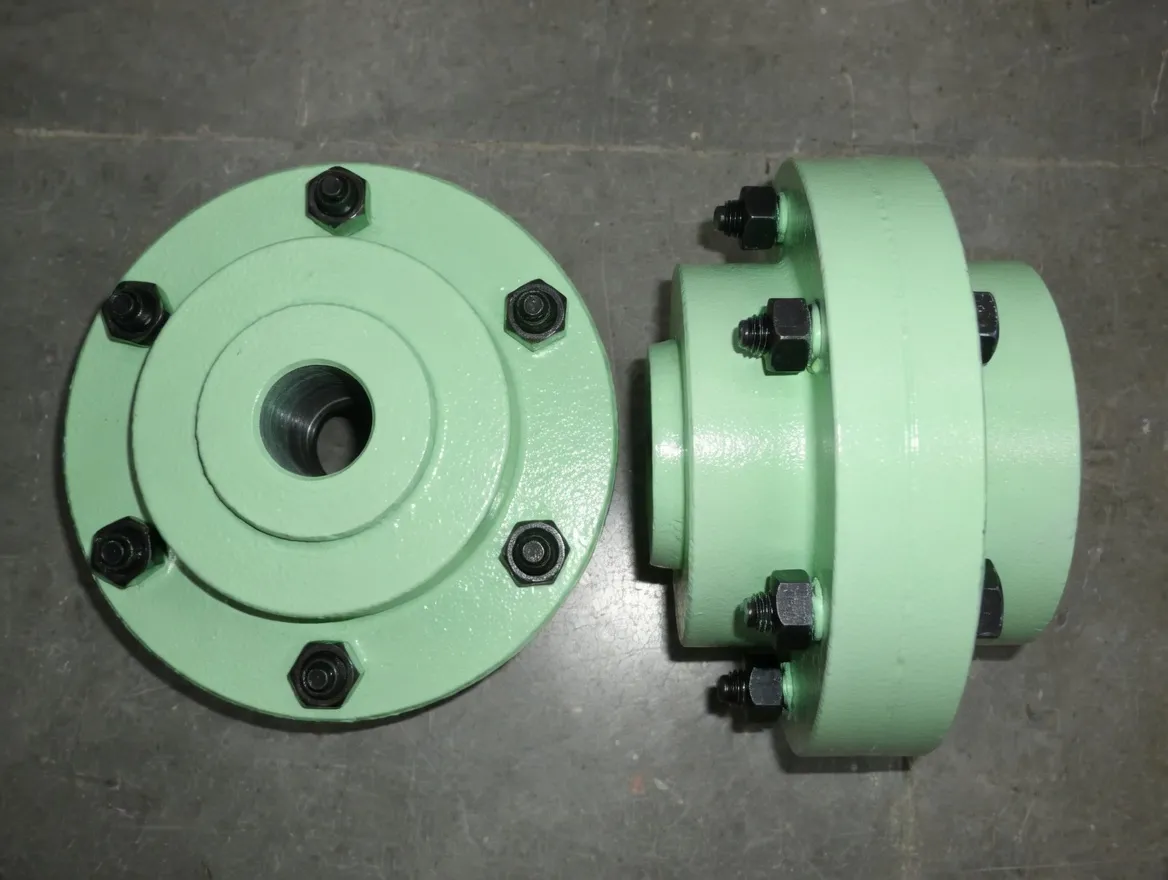 The material science behind a rolling mill gear type coupling is non-negotiable. The hub sleeve teeth must withstand Hertzian contact stresses in excess of 2,000 MPa at peak torque, combined with dynamic impact loading during biting. This demands a carburised and case-hardened alloy steel — typically 18CrNiMo7-6 or its equivalent in EN 10084 — ground to a tooth flank surface finish of Ra 0.8 µm or better after heat treatment. The core toughness of these nickel-chromium-molybdenum steels is equally important: a brittle coupling that shatters on the first heavy bite is far more dangerous and costly than one that shows gradual tooth wear.
The outer drum, subject to lower Hertzian stresses but significant centrifugal loading at higher spindle speeds, is typically manufactured from 42CrMo4 (EN 10083-3), quenched and tempered to 280–320 HB. Flanged connections between drum halves use high-tensile friction-grip bolting, pre-loaded to controlled tension to resist the separation forces generated during angular operation. The intermediate shaft — whether solid or hollow — must be designed against both torsional and bending fatigue, and in mill spindle applications is often fitted with hydraulic press-fit connections at each end to allow rapid roll change without the use of keys, which are points of fretting fatigue initiation in reversing applications. The entire assembly is subject to dynamic balancing at operating speed and must meet residual unbalance limits per ISO 21940 to prevent bearing overload at the gearbox output shaft.
Why Plant Engineers Across the UK Specify Gear Type Couplings for Mill Drives
Extreme Torque Capacity
Gear tooth engagement across the full face width distributes load far more efficiently than jaw or disc couplings, enabling torque transmission from tens of thousands to millions of N·m within compact envelope dimensions.
Shock Load Tolerance
The crowned tooth geometry and lubricated mesh act as a mechanical buffer, absorbing the instantaneous torque spikes that occur at biting and during cobble events, protecting gearbox internals and motor shaft ends from fatigue damage.
Misalignment Compensation
Angular capacity of 1.5° per gear set, combined with axial float, means the coupling follows the roll gap without imposing bending moments on precision gearbox output bearings — a critical protection against bearing failure under thermal cycling.
Long Service Intervals
When correctly lubricated and sealed, a quality gear type coupling will routinely run for 50,000 to 100,000 hours between overhauls in normal mill service — a service life that directly reduces planned maintenance downtime and lowers total cost of ownership.
Rapid Roll Change Compatibility
Split drum designs and hydraulic press-fit spindle ends enable roll changes in under 20 minutes on modern continuous mills, supporting the tight campaign scheduling that UK flat product and long product producers demand to meet customer delivery windows.
High Transmission Efficiency
Transmission efficiency of the gear type coupling typically exceeds 99% at rated conditions — important in high-power mill drives where even fractional efficiency losses translate into significant energy costs and additional heat generation in the drivetrain.
Application Scenarios in the Rolling Mill Main Drive System
Motor ↔ Gearbox Junction
Compensates for foundation settlement, thermal growth of motor frame, and vibration decoupling. Typically a rigid-hub WGZ or SWC series coupling rated 1.5× motor rated torque.
Gearbox ↔ Mill Stand Spindle
The most demanding position. Long intermediate spindle with double gear sets at each end; must handle full angular range during roll change and full torque during rolling. Hydraulic hub-to-shaft fitting is standard.
Hot Strip Continuous Finishing
Seven or more finishing stands run at up to 20 m/s exit speed. Couplings must be precision-balanced and rated for continuous high-cycle operation with minimal vibration to avoid strip surface defects.
Bar and Rod Mills
Higher number of stands with lower individual torque. Compact SWC designs allow minimal stand spacing. Must resist cobble shock from bar looping and pass-line variation in smaller section sizes.
Reversing Plate Mill
Multi-pass reversing imposes bidirectional torque reversal on the gear teeth. Coupling design must account for backlash control and tooth load reversal fatigue, often requiring a preloaded connection design.
Cold Rolling and Skin Pass
Lower torque, higher speed, tighter strip tolerances. The gear type coupling must run with very low vibration levels to avoid roll chatter marks. Dynamic balancing to G1.0 or better is often specified.
Selection Guide: Choosing the Right Gear Type Coupling for Your Rolling Mill
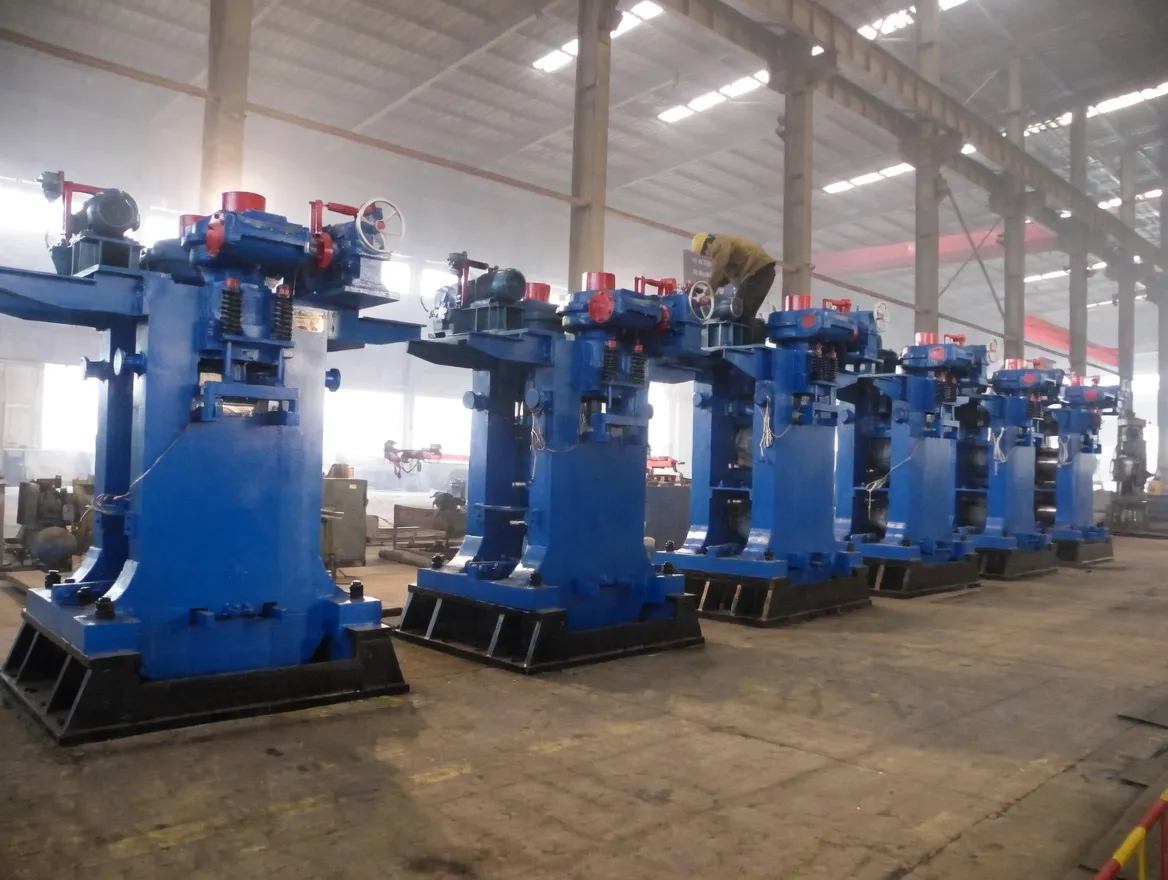 Correct selection begins with a comprehensive torque analysis. The rated torque of the coupling must be based on the motor rated torque multiplied by a service factor that accounts for the application severity. For rolling mill main drives, the service factor is typically in the range of 2.5 to 4.0 depending on whether the mill is a continuous finishing stand (lower factor) or a heavy reversing blooming mill (higher factor). The peak torque at biting must be explicitly checked against the coupling’s catalogued peak capacity, not just the rated figure.
Beyond torque, the angular misalignment operating condition — not just the maximum possible misalignment — must be evaluated. A coupling that runs at or near its maximum angular capacity continuously will suffer elevated tooth wear and grease breakdown rates. For installations where roll gap adjustment requires frequent movement through the full angular range, an arc-tooth (SWC type) ข้อต่อเกียร์ provides smoother tooth contact and longer life than a straight-tooth design. The SWC series, based on the arcuate tooth form, is particularly well suited to spindle applications where the angular displacement is dynamic and continuous rather than static and infrequent.
Lubrication strategy is equally critical. In high-temperature environments near the hot strip mill, grease-lubricated couplings must use a high-temperature, anti-wear grease with a dropping point well above 200 °C — standard NLGI 2 lithium grease is marginal in this environment. Circulating oil systems using ISO VG 220 gear oil are preferable for large, high-speed spindles operating continuously. The seal design must be verified for the IP level required given the mill environment, and seal replacements should be factored into the planned maintenance schedule as a routine task.
Customer Success: Proven Performance in Real Mill Environments
Case Study: Continuous Hot Strip Mill Spindle Replacement — South Wales, UK
A long-established flat products manufacturer operating a 6-stand hot strip finishing mill in South Wales had experienced repeated spindle coupling failures at the F3 and F4 stands, typically occurring within 14 months of installation with a competitor’s product. Failure analysis identified tooth fatigue due to inadequate crown radius specification for the actual angular operating conditions, combined with grease breakdown at the ambient temperatures observed on that part of the mill floor (routinely 55–70 °C ambient). Ever Power supplied WGZ-type arc-tooth spindle couplings rated at 280,000 N·m, with high-temperature lithium-complex grease and upgraded labyrinth seals. After 28 months of continuous service — through two scheduled maintenance shutdowns where the couplings were inspected, re-greased, and returned to service — no tooth wear beyond normal run-in polish has been detected. The customer has since converted all seven finishing stands to Ever Power couplings, with a calculated saving of over £180,000 per year in unplanned downtime and spare parts costs.
“We’ve run Ever Power gear couplings on our rod mill main drives for three full campaigns without a single unplanned coupling-related stop. The custom bore dimensions and keyway tolerances were exactly to our drawing. Delivery to Sheffield was faster than any domestic supplier could match.”
— Maintenance Manager, Long Products Mill, Sheffield, UK
“Our plate mill reversing coupling had to be non-standard — longer spindle, heavier drum wall, modified flange bolt pattern to interface with our existing gearbox. Ever Power’s engineering team handled the design changes in under two weeks and supplied full material certificates and inspection reports. Quality was outstanding.”
— Plant Engineer, Plate Mill, Scunthorpe, UK
“Price-wise they were very competitive against European alternatives, and the lead time of 6 weeks for a custom 180,000 N·m coupling was better than we expected. We’ve been using them for our cold strip skin pass mill for two years now — no chatter issues, clean seals, and the surface finish on our strip has actually improved since we changed over.”
— Procurement Director, Cold Rolling Division, Motherwell, Scotland, UK
Ever Power: Custom Engineering Capability for UK Steel Industry Requirements
Ever Power operates a dedicated manufacturing facility equipped with CNC gear hobbing and grinding centres capable of producing external and internal gear teeth to DIN 5 accuracy on components up to 2,500 mm outer diameter. Heat treatment is performed in-house using computer-controlled gas carburising furnaces with precise case depth and hardness profile control, ensuring every coupling meets its specification regardless of batch size. For UK rolling mill customers, the company’s engineering team provides a complete application review service: analysis of your existing drivetrain loading data, wear pattern assessment on returned couplings, and recommendations for torque rating, crown radius, and lubrication strategy that are specific to your mill type, rolling programme, and maintenance regime.
Product customisation capabilities include: non-standard bore diameters and keyway configurations, modified flange bolt circle patterns to match existing gearbox flanges, extended intermediate shaft lengths for wide mill stands, hydraulic interference fit hubs for zero-key spindle applications, special seal designs for extreme contamination environments, and bespoke surface treatment packages including hot-dip galvanising, Dacromet, or Xylan coatings for specific corrosion resistance requirements. All custom orders are supplied with full material traceability documentation, dimensional inspection reports, and hardness test certificates — the standard compliance package required by UK engineering procurement.
Serving the UK Steel and Metals Manufacturing Sector
The United Kingdom’s steel industry operates across a diverse range of sites — from the integrated flat products operations in Port Talbot, South Wales, to the electric arc furnace long products facilities in Sheffield and Rotherham, the plate mill in Scunthorpe, and the strip mills of Scotland. Each of these operations presents slightly different coupling requirements driven by mill age, product mix, roll change frequency, and maintenance philosophy. Ever Power works directly with UK procurement and engineering teams to specify coupling solutions that match not only the technical requirements but also the commercial constraints of each site, including lead time, stock holding strategy, and compatibility with existing maintenance contractor frameworks.
For UK buyers sourcing gear type couplings for rolling mill applications, the practical considerations include import duty classification, CE marking requirements for machinery directive compliance, and the availability of UK-based technical support for installation and commissioning. Ever Power’s export team handles all documentation requirements for UK imports including full compliance packs with EN standard test reports, and can arrange third-party inspection at the manufacturing facility for high-value orders. Requests for quotes, technical drawings, or application discussions are welcomed directly via email to [email protected].
คำถามที่พบบ่อย
Ready to Specify Your Rolling Mill Gear Type Coupling?
Send your torque data, shaft dimensions, and application details to our engineering team for a fast, accurate quotation.
แก้ไขโดย gzl