विवरण
Precision Power Transmission · UK Industrial Supply
जबड़े का लचीला युग्मन
The industrial workhorse for torque transmission, misalignment compensation, and vibration isolation — trusted by engineers across the United Kingdom from automotive plants in the Midlands to offshore pump stations in Aberdeen.
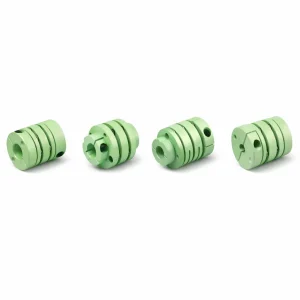
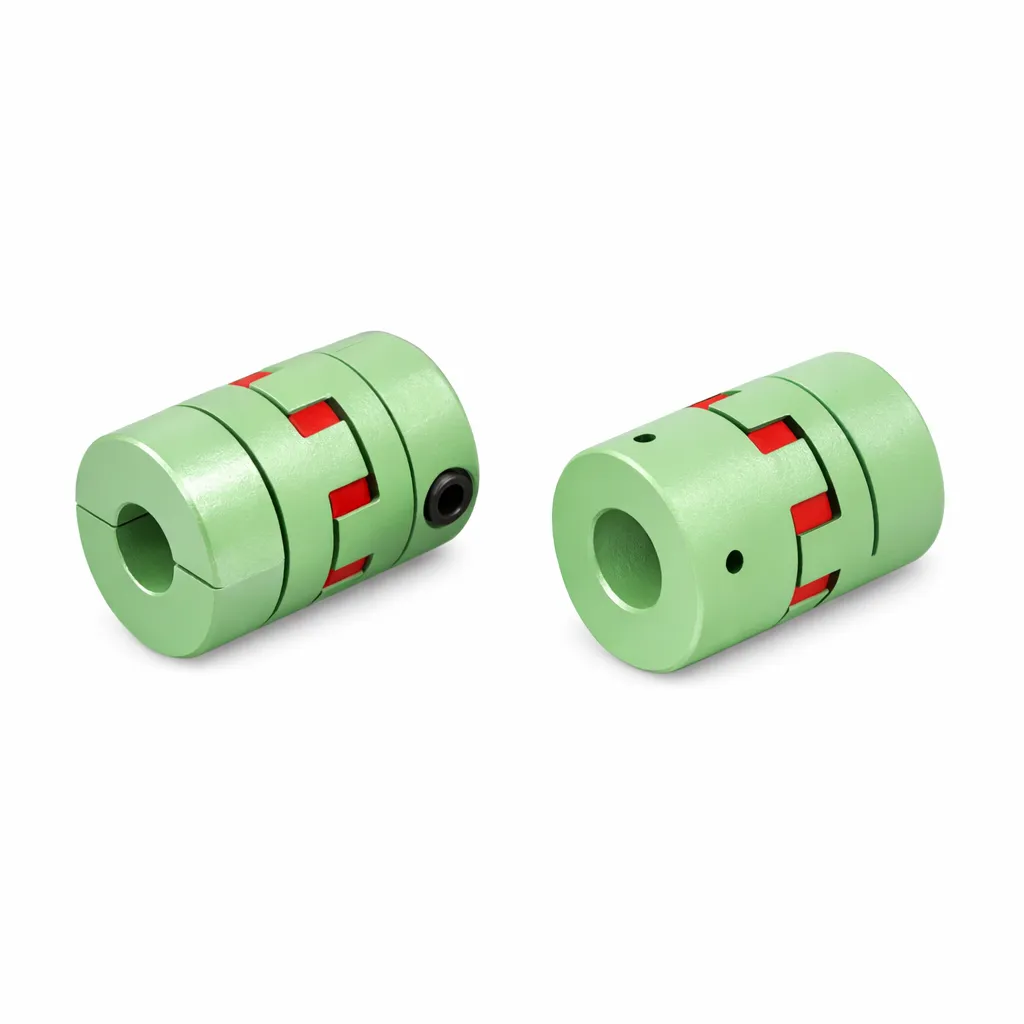 A jaw flexible coupling — sometimes called a spider coupling or claw coupling — is a three-piece mechanical device comprising two metal hubs and an elastomeric spider element seated between them. When shafts rotate, the spider’s lobes transmit torque by compressing between the jaws of each hub, simultaneously absorbing shock loads and damping torsional vibrations before they reach sensitive bearings, gearboxes, or encoders. This elegant mechanism has earned jaw flexible couplings a permanent position in the toolkit of British design engineers working across power generation, food processing, robotics, and heavy plant machinery. The combination of misalignment tolerance, zero-backlash transmission in premium grades, and remarkably simple two-bolt installation makes this coupling a go-to component whenever reliability and uptime matter.
Why Jaw Flexible Couplings Outperform the Competition
उच्च टॉर्क घनत्व
Despite their compact envelope, jaw flexible couplings deliver impressive torque ratings — from 2 N·m in miniature automation sizes right up to over 13,500 N·m in heavy-duty industrial frames. This power-to-size ratio makes them invaluable in UK machine builders’ designs where cabinet space or shaft centre distances are tightly constrained. The direct jaw-to-spider contact geometry transfers load efficiently with minimal energy loss, keeping drive train temperatures low even in continuous-duty cycles.
Three-Axis Misalignment Compensation
Field-installed machinery is rarely perfectly aligned. Jaw flexible couplings accommodate angular misalignment up to 1°, parallel (lateral) offset up to 0.5 mm, and axial float that varies by series. The polyurethane or NBR spider element flexes and recovers elastically, absorbing misalignment forces instead of transmitting them as destructive side-loads into motor bearings or pump seals — a critical advantage in UK facilities where thermal expansion and concrete settling are everyday realities.
Shock Absorption & Vibration Damping
The elastomeric spider acts as a torsional spring-damper. When a piston compressor fires or a conveyor encounters a jam, the spider element stretches and recovers, converting kinetic shock energy into negligible heat rather than propagating impulse forces through the drive chain. Operators in British packaging plants and quarrying operations consistently report reduced bearing replacement frequency after upgrading to jaw-type couplings — a measurable impact on maintenance budgets and overall equipment effectiveness.
Fast Maintenance — No Lubrication
Unlike gear couplings, jaw flexible couplings require zero lubrication and no scheduled grease intervals, dramatically reducing lifetime maintenance costs. Spider elements are inspectable and replaceable without moving shafts axially — simply loosen the set screws, slide each hub back, and swap the spider. For UK plants operating under tight OEE targets, this translate to planned maintenance windows measured in minutes, not hours. The split-spider design available in larger series takes this convenience even further.
तकनीकी प्रदर्शन पैरामीटर
The table below summarises representative performance data across common jaw flexible coupling size ranges. Values are indicative; contact our engineering team for series-specific datasheets and confirmation for your application torque, speed, and bore requirements.
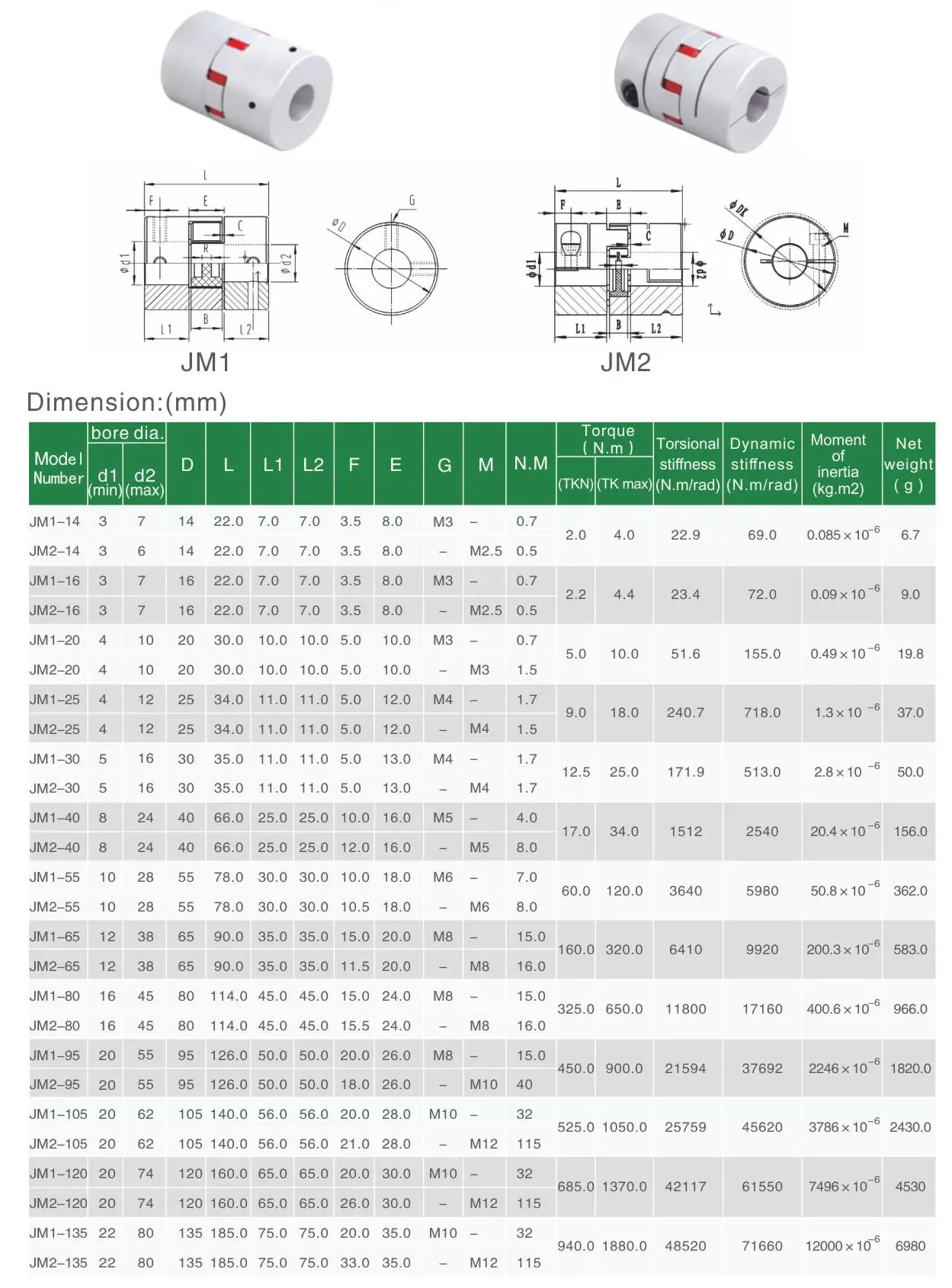
Spider elements available in NBR (standard), Polyurethane (98 Shore A, high-load), Hytrel (high-temp), and Bronze-insert (fail-safe).
Material Science & Working Principle
Hub Materials
Hubs in small sizes (bore ≤ 28 mm) are typically precision-machined from 6061-T6 aluminium alloy, balancing low inertia with adequate strength for servo and stepper motor drives. Mid-range sizes transition to GG25 grey cast iron or ductile iron for improved wear resistance at keyway interfaces. Heavy-duty series above 600 N·m employ EN8 or EN24 forged steel hubs, heat-treated to 260–300 HB, which resist fretting corrosion even in high-cycle applications like compressors running 24 hours a day at petrochemical sites around Teesside and Grangemouth.
Spider Element
The spider’s material grade is the primary tuning parameter. Standard NBR (Nitrile Butadiene Rubber, Shore 80A) offers excellent oil resistance and suits most general industrial applications from 30°C to +80°C. For higher dynamic loads — robotics, servo axes, printing presses — a 98 Shore A polyurethane spider provides stiffer torsional characteristics and lower backlash, acceptable for positioning accuracy down to ±0.1°. Hytrel thermoplastic elastomer spiders extend the operating temperature ceiling to +120°C, making them the choice for food-safe washdown environments and proximity to process ovens.
Transmission Mechanism
Torque transmission is purely compressive: each jaw on the driving hub presses against a corresponding spider lobe, which simultaneously bears against the mating jaw on the driven hub. No adhesive bond, no shear-loaded bolt — just elastomer compression, which is inherently tolerant of impact and reversal. During misalignment the spider lobes flex unevenly, distributing contact stress dynamically across multiple lobes so no single contact point is overloaded. This distributed load sharing is why jaw flexible couplings outlast single-element flex couplings in applications with frequent start-stop reversals, a common profile in UK materials handling and HVAC variable-speed pump drives.
Industry Applications Across the UK
Jaw flexible couplings serve an exceptionally broad range of sectors. In United Kingdom automotive manufacturing — particularly in body-in-white welding cells, transfer lines at the Jaguar Land Rover plant in Solihull, or component machining at Tier 1 suppliers in the West Midlands — these couplings connect servo motors to precision ballscrew axes where low backlash and shock damping protect expensive linear guides. Conveyor and material handling engineers specify them on motorised roller drives throughout distribution centres operated by major UK logistics companies, where the couplings’ plug-in spider replacement means overnight maintenance teams can restore a line without specialist tools. Water utilities across England and Scotland rely on jaw flexible couplings to connect horizontal split-case pump shafts to VFD-driven motors, with NBR spiders resisting the moisture and occasional shaft run-out from thermally cycled pump casings. Robotics integrators building collaborative robot cells for UK pharmaceutical manufacturers favour stainless-steel hub variants that comply with BS EN ISO 22000 surface finish requirements and tolerate hydrogen peroxide vapour sterilisation. The sheer range of available bore sizes, keyway configurations, and hub face distances means specifying engineers can almost always find a standard jaw flexible coupling that fits without bespoke machining — and when they cannot, our factory’s custom bore and keyway service fills the gap within four working days.
Industrial Machinery
Automotive & EV
Robotics & Automation
Pumps & Compressors
Conveyor Systems
Pharma & Food
Customer Success Story
Northgate Fluid Systems Ltd — Leeds, West Yorkshire
Industrial Pump OEM · 2023 Project
चुनौती: Northgate Fluid Systems was redesigning a range of close-coupled centrifugal pumps for the UK water treatment sector. Their existing disc-pack couplings were transmitting motor vibration into thin-wall pump casings, causing premature mechanical seal failures every 6–8 months. The engineering team needed a coupling that could handle 110 N·m at 2,900 rpm, tolerate up to 0.4 mm of parallel misalignment from thermal growth in the pump volute, and survive a continuous wash-down environment with pH 8.5 water.
समाधान: We supplied L095 jaw flexible couplings with polyurethane spiders and 316 stainless steel set screws. Our applications engineer reviewed their shaft layout drawings and confirmed the standard keyway-to-keyway distance matched their bell-housing design without adaptor plates. A sample batch of 20 units was despatched from our UK distribution stock within three business days — meeting Northgate’s prototype build deadline.
Result: After 18 months of field operation across 40 installed pump units at three water utility sites in Yorkshire and the North East, mechanical seal life extended from 7 months to over 22 months. Northgate’s product manager calculated an annual maintenance saving of approximately £38,000 across the installed fleet. The coupling has since been written into their standard BOM for the entire pump series.
What UK Engineers Say
“We’ve been specifying jaw flexible couplings from this supplier for our conveyor head-drive assemblies at our Coventry distribution centre. Delivery to the UK was fast, the bore tolerances were spot-on, and the spiders are still going strong after two years of three-shift operation. We wouldn’t use anything else.”
— Mark T., Lead Mechanical Engineer
Logistics & Distribution, Coventry
“I needed a custom bore of 22 mm with a 6 mm keyway on an L070 hub — a non-standard size. The team machined it to my drawing and had it with me in Bristol within a week. The finish and runout were excellent. Highly professional service with genuinely competitive pricing against UK catalogue distributors.”
— Sarah L., Automation Systems Designer
Robotics Integrator, Bristol
“Our gas compressor skids in Aberdeen needed heavy-duty jaw couplings rated above 2,000 N·m. The L276 units arrived with full material certs and dimensional inspection reports — exactly what our quality control team requires for safety-critical oil and gas applications. We’ve placed repeat orders four times in the past year.”
— James F., Rotating Equipment Engineer
Upstream Oil & Gas, Aberdeen, Scotland
फ़ैक्टरी और कस्टम इंजीनियरिंग क्षमता
Our manufacturing facility operates a full suite of CNC turning centres, machining centres, and gear hobbing machines supported by dedicated metrology cells with CMM inspection. This integrated production model allows us to offer jaw flexible coupling customisation that most catalogue distributors simply cannot match. Hub bore diameters, keyway dimensions, key depth, and set screw positions are all modifiable to customer drawings — typically within a four-to-five working day lead time for quantities up to 50 pieces.
Beyond dimensional customisation, our engineering team supports UK OEM customers in selecting the correct spider durometer for their specific torque signature. We provide torsional stiffness calculations, natural frequency estimates for resonance avoidance, and application-specific shaft fit recommendations (H7/k6 interference or H7/g6 clearance). For customers developing new machinery, we can supply pre-production samples of prototype couplings within 72 hours to accelerate design validation cycles.
Surface treatment options — zinc plating, nickel plating, black oxide, and food-grade electroless nickel — are available to specification, ensuring compliance with sector-specific standards whether your application is in a UK food factory, an offshore platform, or a semiconductor clean room. Our quality management system operates to ISO 9001 and we issue full material certifications, hardness test records, and CMM dimensional reports on request, satisfying the documentation requirements of British Tier 1 manufacturers and procurement teams.
⚙ Custom Bore & Keyway
Any bore from 4 mm to 140 mm, DIN 6885 or imperial keyways
🧪 Material Selection Guidance
Aluminium, cast iron, steel, stainless; spider durometer from 64A–98A
📋 Full Documentation Pack
Material certs, CMM reports, hardness records — standard on request
✈ Fast Despatch to UK
Stock items shipped within 24–48 hrs; custom parts 4–5 working days
अक्सर पूछे जाने वाले प्रश्नों
What is the best jaw flexible coupling supplier in the UK for industrial pump applications, and how quickly can I get a quote?
For industrial pump applications across the UK — whether you’re maintaining water treatment infrastructure in Yorkshire, upgrading chemical dosing pumps in Teesside, or specifying a close-coupled pump range for OEM sale — a jaw flexible coupling with a polyurethane spider (98 Shore A) rated at the motor’s full-load torque with a 1.5× service factor is typically the right starting point. To get a price and lead time, email [email protected] with your bore sizes, shaft centre distance, operating torque, and speed. You’ll receive a quotation within one business day.
How do I choose the right spider durometer hardness for my jaw flexible coupling in a high-shock conveyor application?
In conveyor applications with frequent start-stop cycling or belt-jam conditions — common in UK logistics warehouses and quarrying operations — a softer spider (NBR 64–80 Shore A) absorbs peak shock loads more effectively, protecting gearbox bearings and motor shafts. However, if the application involves frequent reversals or position control, a harder 98A polyurethane spider delivers lower torsional wind-up and tighter positioning repeatability. The trade-off is reduced shock absorption, so a service factor of at least 1.75 is recommended. If you’re unsure, our application engineers can model the peak torque and advise on the optimum spider grade for your specific duty cycle.
Where can I buy jaw flexible couplings with custom bores in the UK, and what is the typical lead time and cost?
Custom bore jaw flexible couplings are available directly from our factory and despatched to anywhere in the United Kingdom. Bore diameters from 4 mm to 140 mm, with DIN 6885 standard or imperial keyways, are machinable to your drawing. For quantities of 1–50 pieces, the standard lead time is four to five working days after drawing approval. Pricing depends on the series and bore combination; orders above 10 pieces typically carry volume pricing that undercuts UK catalogue distributors by 20–40%. Contact [email protected] with your drawing or specification for a firm price.
Which jaw flexible coupling size do I need for a 7.5 kW motor running at 1,450 rpm in a UK food processing plant?
A 7.5 kW motor at 1,450 rpm generates approximately 49 N·m of full-load torque (T = P × 9550 / n). Applying a service factor of 2.0 for food processing — which involves frequent wash-downs, potential overloads from product jams, and hygienic requirements — gives a design torque of around 98 N·m. An L095 series jaw flexible coupling (rated 56–130 N·m depending on spider grade) in stainless steel hub configuration with a food-grade Hytrel spider is the appropriate selection. This combination also meets the hygiene surface finish expectations common in UK BRC and BRCGS-certified food factories.
Can jaw flexible couplings be used in outdoor applications in the UK, and do they handle the wet climate well?
Yes — jaw flexible couplings with cast iron or steel hubs and NBR spiders perform reliably outdoors in the UK’s temperate wet climate. NBR rubber has good water and mild oil resistance, and the spider sits recessed between hub flanges, providing natural rain-shedding geometry. For fully exposed outdoor installations on water treatment sites, irrigation pump stations, or renewable energy equipment, we recommend ordering hubs with zinc or nickel plating to prevent corrosion at bore and keyway surfaces. For coastal or offshore environments in locations such as Aberdeen, Shetland, or along the English Channel coast, stainless steel hub versions with stainless fasteners are the appropriate choice.
How often should I replace the spider element in a jaw flexible coupling used in a British manufacturing plant?
Spider replacement interval depends heavily on operating conditions. As a general guideline for continuous 8-hour shift operation at rated torque, NBR spiders typically last 12–24 months before showing measurable torsional backlash increase. Polyurethane spiders in the same conditions often last 24–48 months. Key inspection indicators are: cracking or chunking of the lobes, visible permanent compression set reducing lobe height by more than 20%, and any increase in torsional backlash above the application’s tolerance. In British plants running three-shift or 24/7 cycles, checking the spider at each planned maintenance shutdown (typically every 3–6 months) and replacing proactively every 12 months is a cost-effective approach given how inexpensive spider elements are relative to the downtime costs they prevent.
Ready to Source Jaw Flexible Couplings for Your UK Project?
Send us your bore sizes, torque requirement, and speed — and we’ll respond with a competitive price and technical recommendation within one business day.
✉ Contact Us: [email protected]
जीजेडएल द्वारा संपादित